JUDAS MACCABAEUS
A Sacred Drama, by Georg Friedrich Handel (1747) , Words by Thomas Morell
Cast of Characters
Judas Maccabaeus (tenor)
Simon, his Brother (bass)
Israelite Woman (soprano)
Israelite Man (mezzo-soprano)
Eupolemus, the Jewish Ambassador to Rome (alto)
First Messenger (alto)
Second Messenger (bass)
Chorus of Israelites
Chorus of Youths
Chorus of Virgins
ACT ONE
1. (Overture) Scene 1
Chorus of Israelites, men and women, lamenting the death of Mattathias, the father of Judas Maccabaeus.
2. Chorus of Israelites:
Mourn, ye afflicted children, the remains
Of captive Judah, mourn in solemn strains;
Your sanguine hopes of liberty give over,
Your hero, friend and father is no more.
3. (Recitative) Israelite Man:
Well, may your sorrows, brethren, flow
In all the expressive signs of woe:
Your softer garments tear,
And squalid sackcloth wear,
Your drooping heads with ashes strew,
And with the flowig tear your cheeks bedew.
Israelite Woman:
Daughters, let your distressful cries
And loud lament ascend the skies;
Your tender bosoms beat, and tear,
With hands remorseless, your dishevelled hair;
For pale and breathless Mattathias lies,
Sad emblem of his country's miseries!
4. (Duet) Israelite Woman and Man:
From this dread scene, these adverse powers,
Ah, whither shall we fly?
O Solyma! Thy boasted towers
In smoky ruins lie.
5. Chorus of Israelites:
For Sion lamentation make,
With words that weep, and tears that speak.
6. (Recitative) Israelite Man
Not vain is all this storm of grief;
To vent our sorrows, gives relief.
Wretched indeed! But let not Judah's race
Their ruin with desponding arms embrace.
Distractful doubt and desperation
Ill become the chosen nation,
Chosen by the great I AM,
The Lord of hosts, who, still the same,
We trust, will give attentive ear
To the sincerity of prayer.
7. (Air) Israelite Man
Pious orgies, pious airs,
Decent sorrow, decent pray'rs,
Will to the Lord ascend, and move
His pity, and regain His love.
8. Chorus of Israelites:
O Father, whose Almighty power
The Heavens, and earth, and seas adore;
The hearts of Judah, thy delight,
In one defensive band unite.
And grant a leader bold, and brave,
If not to conquer, born to save.
9. (Accompagnato) Simon:
I feel, I feel the deity within,
Who, the bright cherubim between,
His radiant glory erst displayed;
To Israel's distressful prayer
He hath vouchsafed a gracious ear,
And points out Maccabaeus to their aid:
Judas shall set the captive free,
And lead us all to victory.
10. (Air) Simon:
Arm, arm, ye brave! A noble cause,
The cause of Heaven your zeal demands.
In defence of your nation, religion, and laws,
The Almighty Jehovah will strengthen your hands.
Arm, arm. . . da capo
11. Chorus of Israelites:
We come, we come, in bright array,
Judah, thy sceptre to obey.
12. (Recitative) Judas Maccabaeus:
'Tis well, my friends; with transport I behold
The spirit of our fathers, famed of old
For their exploits in war. Oh, may they fire
With active courage you, their sons inspire:
As when the mighty Joshua fought,
And those amazing wonders wrought,
Stood still, obedient to his voice, the sun,
Till kings he had destroyed, and kingdoms won.
13. (Air) Judas Maccabaeus
Call forth thy powers, my soul, and dare
The conflict of unequal war.
Great is the glory of the conquering sword,
That triumphs in sweet liberty restor'd.
Call forth. . . da capo
14. (Recitative) Israelite Woman:
To Heaven's Almighty king we kneel,
For blessings on this exemplary zeal.
Bless him, Jehovah, bless him, and once more
To thy own Israel liberty restore.
15. (Air) Israelite Woman:
O liberty, thou choicest treasure,
Seat of virtue, source of pleasure!
Life, without thee, knows no blessing,
No endearment worth caressing.
16. (Air) Israelite Woman:
Come, ever-smiling liberty,
And with thee bring thy jocund train.
For thee we pant, and sigh for thee,
With whom eternal pleasures reign.
Come. . . da capo
17. (Recitative) Israelite Man
O Judas, may these noble views inspire
All Israel with thy true heroic fire!
18. (Air) Israelite Man
'Tis liberty, dear liberty alone,
That gives fresh beauty to the sun;
That bids all nature look more gay,
And lovely life with pleasure steal away.
19. (Duet) Israelite Woman and Man
Come, ever-smiling liberty,
And with thee bring thy jocund train.
For thee we pant, and sigh for thee,
With whom eternal pleasures reign.
20. Chorus of Israelites:
Lead on, lead on! Judah disdains
The galling load of hostile chains.
21. (Recitative) Judas Maccabaeus:
So willed my father now at rest
In the eternal mansions of the blest:
'Can ye behold,' said he 'the miseries,
In which the long-insulted Judah lies?
Can ye behold their dire distress,
And not, at least, attempt redress?'
Then, faintly, with expiring breath,
'Resolve, my sons, on liberty, or death!'
We come! Oh see, thy sons prepare
The rough habiliments of war;
With hearts intrepid, and revengeful hands,
To execute, O sire, thy dread commands.
22. Semi-chorus of Israelite Men:
Disdainful of danger, we'll rush on the foe,
That Thy power, O Jehovah, all nations may know.
23. (Recitative) Judas Maccabaeus
Ambition! If ever honour was thine aim,
Challenge it here:
The glorious cause gives sanction to thy claim.
24. (Air) Judas Maccabaeus:
No unhallowed desire
Our breasts shall inspire,
Nor lust of unbounded power!
But peace to obtain:
Free peace let us gain,
And conquest shall ask no more.
25. (Recitative) Israelite Man:
Haste we, my brethren, haste we to the field,
Dependant on the Lord, our strength and shield.
26. Chorus of Israelites:
Hear us, O Lord, on Thee we call,
Resolved on conquest, or a glorious fall.
ACT TWO
27. Chorus of Israelites:
Fallen is the foe; so fall Thy foes, O Lord,
Where warlike Judas wields his righteous sword!
28. (Recitative) Israelite Man
Victorious hero! Fame shall tell,
With her last breath, how Apollonius fell,
And all Samaria fled, by thee pursued
Through hills of carnage and a sea of blood;
While thy resistless prowess dealt around,
With their own leader's sword, the deathful wound.
Thus, too, the haughty Seron, Syria's boast,
Before thee fell with his unnumbered host.
29. (Air) Israelite Man:
So rapid thy course is,
Not numberless forces
Withstand thy all-conquering sword.
Though nations surround thee,
No pow'r shall confound thee,
Till freedom again be restored.
So rapid. . . da capo
30. (Recitative) Israelite Man:
Well may we hope our freedom to receive,
Such sweet transporting views thy actions give.
31. (Duet) Israelite Woman and Man
Zion now her head shall raise,
Tune your harps to songs of praise.
32. (Chorus) Israelites
Zion now her head shall raise,
Tune your harps to songs of praise.
33. (Recitative) Israelite Woman:
Oh, let eternal honours crown his name:
Judas, first worthy in the rolls of fame.
Say, 'He put on the breast-plate as a giant,
And girt his warlike harness about him;
In his acts he was like a lion,
And like a lion's whelp roaring for his prey.'
34. (Air) Israelite Woman:
From mighty kings he took the spoil,
And with his acts made Judah smile.
Judah rejoiceth in his name,
And triumphs in her hero's fame.
From mighty kings. . . da capo
35. (Duet) Israelite Woman and Man
Hail, hail, Judea, happy land!
Salvation prospers in his hand.
36. (Chorus) Israelites:
Hail, hail, Judea, happy land!
Salvation prospers in his hand.
37. (Recitative) Judas Maccabaeus:
Thanks to my brethren; but look up to Heaven;
To Heaven let glory and all praise be given;
To Heaven give your applause,
Nor add the second cause,
As once your fathers did in Midian,
Saying, 'The sword of God and Gideon.'
It was the Lord that for his Israel fought,
And this our wonderful salvation wrought.
38. (Air) Judas Maccabaeus:
How vain is man, who boasts in fight
The valour of gigantic might!
And dreams not that a hand unseen
Directs and guides this weak machine.
How vain. . . da capo
39. (Recitative) First Messenger:
O Judas, O my brethren!
New scenes of bloody war
In all their horrors rise.
Prepare, prepare,
Or soon we fall a sacrifice
To great Antiochus; from the Egyptian coast,
(Where Ptolemy hath Memphis and Pelusium lost)
He sends the valiant Gorgias, and commands
His proud, victorious bands
To root out Israel's strength, and to erase
Every memorial of the sacred place.
40. (Air) Israelite Woman:
Ah! wretched, wretched Israel! fallen, how low,
From joyous transport to desponding woe.
41. (Chorus) Israelites:
Ah! wretched, wretched Israel! fallen, how low,
From joyous transport to desponding woe.
42. (Recitative) Simon:
Be comforted, nor think these plagues are sent
For your destruction, but for chastisement.
Heaven oft in mercy punisheth, that sin
May feel its own demerits from within,
And urge not utter ruin. Turn to God,
And draw a blessing from His iron rod.
43. (Air) Simon:
The Lord worketh wonders
His glory to raise;
And still, as he thunders,
Is fearful in praise.
44. (Recitative) Judas Maccabaeus:
My arms! Against this Gorgias will I go.
The Idumean governor shall know
How vain, how ineffective his design,
While rage his leader, and Jehovah mine.
45. (Air) Judas Maccabaeus:
Sound an alarm! Your silver trumpets sound,
And call the brave, and only brave, around.
Who listeth, follow: to the field again!
Justice with courage is a thousand men.
Sound an alarm. . . da capo
46. Chorus
We hear, we hear the pleasing dreadful call,
And follow thee to conquest; if to fall,
For laws, religion, liberty, we fall.
47. (Recitative) Simon:
Enough! To Heaven we leave the rest.
Such generous ardour firing every breast,
We may divide our cares; the field be thine,
O Judas, and your sanctuary mine;
For Sion, holy Sion, seat of God,
In ruinous heaps, is by the heathen trod;
Such profanation calls for swift redress,
If ever in battle Israel hopes success.
48. (Air) Simon:
With pious hearts, and brave as pious,
O Sion, we thy call attend,
Nor dread the nations that defy us,
God our defender, God our friend.
49. (Recitative) Israelite Man:
Ye worshippers of God,
Down, down with the polluted altars, down.
Hurl Jupiter Olympius from his throne,
Nor reverence Bacchus with his ivy crown
And ivy-wreathed rod.
Our fathers never knew
Him, or his beastly crew,
Or, knowing, scorned such idol vanities.
Israelite Woman:
No more in Sion let the virgin throng,
Wild with delusion, pay their nightly song
To Ashtoreth, yclep't the Queen of Heaven.
Hence to Phoenicia be the goddess driven,
Or be she, with her priests and pageants, hurled
To the remotest corner of the world,
Never to delude us more with pious lies.
50. (Air) Israelite Woman:
Wise men, flattering, may deceive us
With their vain, mysterious art;
Magic charms can never relieve us,
Nor can heal the wounded heart.
But true wisdom can relieve us,
Godlike wisdom from above;
This alone can never deceive us,
This alone all pains remove.
Wise men. . . da capo
51. (Duet) Israelite Woman and Man:
Oh, never, never bow we down
To the rude stock or sculptured stone.
We worship God, and God alone.
52. Chorus of Israelites:
We never, never will bow down
To the rude stock or sculptured stone.
We worship God, and God alone.
ACT THREE
53. (Air) Israelite Man:
Father of Heaven! From Thy eternal throne,
Look with an eye of blessing down,
While we prepare with holy rites,
To solemnize the feasts of lights.
And thus our grateful hearts employ;
And in Thy praise
This altar raise,
With carols of triumphant joy.
Father of Heaven. . . da capo
54. (Accompagnato) Israelitish Man:
See, see yon flames, that from the altar broke,
In spiring streams pursue the trailing smoke.
The fragrant incense mounts the yielding air;
Sure presage that the Lord hath heard our prayer.
55. (Recitative) Israelite Woman:
Oh, grant it, Heaven, that our long woes may cease,
And Judah's daughters taste the calm of peace,
Sons, brothers, husbands to bewail no more,
Tortur'd at home, or havock'd in the war.
56. (Air) Israelite Woman:
So shall the lute and harp awake,
And sprightly voice sweet descant run,
Seraphic melody to make,
In the pure strains of Jesse's son.
57. (Recitative) First Messenger:
From Capharsalama, on eagle wings I fly,
With tidings of impetuous joy:
Came Lysias, with his host, arrayed
In coat of mail; their massy shields
Of gold and brass, flashed lightning over the fields,
While the huge tower-backed elephants displayed
A horrid front. But Judas, undismayed,
Met, fought, and vanquished all the rageful train.
Yet more, Nicanor lies with thousands slain;
The blasphemous Nicanor, who defied
The living God, and, in his wanton pride,
A public monument ordained
Of victories yet ungained.
Second Messenger:
But lo, the conqueror comes; and on his spear,
To dissipate all fear,
He bears the vaunter's head and hand,
That threatened desolation to the land.
58. (Chorus) Youths:
See, the conqu'ring hero comes!
Sound the trumpets, beat the drums.
Sports prepare, the laurel bring,
Songs of triumph to him sing.
Virgins:
See the godlike youth advance!
Breathe the flutes, and lead the dance;
Myrtle wreaths, and roses twine,
To deck the hero's brow divine.
Israelites:
See, the conqu'ring hero comes!
Sound the trumpets, beat the drums.
Sports prepare, the laurel bring,
Songs of triumph to him sing.
See, the conquering hero comes!
Sound the trumpets, beat the drums.
59. March
60. Soli (alto, tenor) & Chorus of Israelites:
Sing unto God, and high affections raise,
To crown this conquest with unmeasured praise.
61. (Recitative) Judas Maccabaeus:
Sweet flow the strains, that strike my feasted ear;
Angels might stoop from Heav'n to hear
The comely song we sing,
To Israel's Lord and King.
But pause awhile: due obsequies prepare
To those who bravely fell in war.
To Eleazar special tribute pay;
Through slaughtered troops he cut his way
To the distinguished elephant, and, whelmed beneath
The stabbed monster, triumphed in a glorious death.
62. (Air) Judas Maccabaeus:
With honour let desert be crowned,
The trumpet ne'er in vain shall sound;
But, all attentive to alarms,
The willing nations fly to arms,
And, conquering or conquered, claim the prize
Of happy earth, or far more happy skies.
63. (Recitative) Eupolemus:
Peace to my countrymen; peace and liberty.
From the great senate of imperial Rome,
With a firm league of amity, I come.
Rome, whatever nation dare insult us more,
Will rouse, in our defence, her veteran power,
And stretch her vengeful arm, by land or sea
To curb the proud, and set the injured free.
64. Chorus of Israelites
To our great God be all the honour given,
That grateful hearts can send from earth to Heaven.
65. (Recitative) Israelite Woman:
Again to earth let gratitude descend,
Praiseworthy is our hero and our friend.
Come then, my daughters, choicest art bestow,
To weave a chaplet for the victor's brow;
And in your songs for ever be confessed
The valour that preserved, the power that blessed,
Blessed you with hours, that scatter, as they fly,
Soft quiet, gentle love, and boundless joy.
66. (Air Duet) Israelite Woman (and Man):
O lovely peace, with plenty crowned,
Come, spread thy blessings all around.
Let fleecy flocks the hills adorn,
And vallies smile with wavy corn.
Let the shrill trumpet cease, nor other sound
But nature's songsters wake the cheerful morn.
O lovely peace. . . da capo
67. (Air) Simon:
Rejoice, O Judah, and, in songs divine,
With cherubim and seraphim harmonious join!
68. (Chorus) Israelites:
Hallelujah! Amen.
THE END...
May the LORD God bless you in the name of St. Judas Maccabaeus.
SOURCE: Georg Friedrich Händel JUDAS MACCABAEUS (1747). A Sacred Drama. Initially input by Pierre Degott (degott@zeus.univ-metz.fr); HTML conversion by Potharn Imre (pubi@altavista.net)Last updated: Oct. 20, 1999, (http://opera.stanford.edu/iu/libretti/judas.htm)
Showing posts with label Judas Maccabaeus. Show all posts
Showing posts with label Judas Maccabaeus. Show all posts
Thursday, October 28, 2010

Saint Judas Maccabaeus Fact Sheet
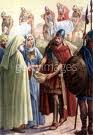
Judas, the Valiant
Maccabee Facts about St. Judas Maccabaeus
The Life of St. Judas Maccabeus
PLACE OF BIRTH: Modi'in (Modein), Judea
PLACE OF DEATH: Elasa (160 BC), near modern day Ramallah
MILITARY SERVICE: Rebel leader and commander of the Maccabees
YEARS OF SERVICE: 167-160 BC
BATTLES/WARS: Revolt of the Maccabees
LEGACY: Military hero, Defender of Judaism, Founder of Hanukkah
PRESTIGE: One of the Nine Worthies, which include nine of the greatest Judeo-Christian warriors of all time
JUDAISM: Seen as one of greatest Jewish warriors in history, alongside Joshua, Gideon and David
ESTABLISHMENT: Founded the holiday of Hanukkah and the Hasmonean Dynasty of Israel
The Faith of St. Judas Maccabaeus
RELIGION: Orthodox Temple Judaism
FAITH: Devout, traditional
BIBLE: Book of the Maccabees I and II
APOCRYPHA: Book of the Maccabees III, IV, and V
OTHER BOOKS: Book of the Maccabees VI, VII, VIII, and the three Ethiopian books of Meqabyan
TRADITION: One of the most celebrated Judeo-Christian heroes in history
JUDAISM: Founder of the festival of Hanukkah (Dedication), an official holiday of Judaism
CHRISTIANITY: Considered a Saint residing in the Christian Kingdom of Heaven
RECOGNITION: Honored by Roman Catholicism, Eastern Orthodox, Ethiopian and Coptic Christianity
CHURCHES: I. St. Mary and St. Shmuni Church, in Sinstorf (Hamburg, Germany), II. Chapel of the Maccabees, in Saint-Pierre, (Geneva, Switzerland), III. St. Maccabees Church, in Cologne, (Germany), IV. Church of St. Maccabees Brothers in Lady, (Poland)
Ancestry of St. Judas Maccabaeus
ROYAL LINE: Hasmonean Dynasty
TRIBE OF ISRAEL: Levi
FAMILY HOUSE: House of Asamoneus
PRIESTHOOD: Seven Watchtowers of Joarib
FATHER: Mattathias the Hasmonean
BIRTH ORDER: Third-born son
BROTHERS: Jonathan Apphus, John Gaddis, Simon Thassi, Eleazar Avaran
FAMILY TOMB: Modi'in, Israel
Various Names of St. Judas Maccabaeus
STANDARD: Judas Maccabeus, Judas Maccabaeus
TITLE: The Hammer, the Hammer of God, the Hammerer
JEWISH: Judah Maccabee, Judah the Maccabee
YIDDISH: Yehudah HaMakabi
LITERAL ENGLISH: Judah the Hammer
HEBREW: יהודה המכבי
ORIGIN: From the Aramaic 'maqqabba', or 'makebet' in modern Hebrew
ALTERNATIVE SPELLINGS: Machabeus, Maccabeus,
The Eternal Laws of St. Judas Maccabaeus
GOD: I. You will accept death over idolatry.
LIFE: II. You will accept death over murder.
SEXUALITY: III. You will accept death over sexual perversion.

The Triumph of Judas Maccabaeus
St. Judas Maccabaeus in Literature
Old English Homilies on The Maccabees, by Aelfric (c. 1000) edited by Stuart D. Lee
El Maccabeo, by Miguel de Silveyra. (Naples, 1638)
La chevalerie de Judas Macabe, by Pierre du Ryer (1600-1658)
Judas Machabaeus, (Rome 1695)
Judas Makkabaeus, by Josef Eduard Konrad Bischoff (Germany 1885)
The Hammer, by Alfred J. Church and Richmond Seeley (1890)
Alilot Gibbor ha-Yehudim Yehudah ha-Makkabi le-Veit ha-Hashmona'im, by Jacob Benjamin Katznelson (1922)
Judas Makkabaeus, ein Kleinvolk kaempft um Glaube und Heimat, by Karl Boxler (1943)
My Glorious Brothers, by Howard Fast (1948)
Yehudah ha-Makkabi in A Layter tsu der Zun, by Moses Schulstein (1954)
Yehudah ha-Makkabi in Sippurim le-Mofet, by Jacob Fichmann (1954)

King David with Judas on Right
St. Judas Maccabaeus in Theatre
Judas Maccabeaus, by William Houghton (1601)
Giuda Maccabeo, ossia la morte di Nicanore, an Oratorio adapted by Vallicella (1839)
Judas Maccabaeus, by Henry Wadsworth Longfellow (1872)
St. Judas Maccabaeus in Art
The illustrated manuscript Libri Maccabaeorum (900s AD).
Josephus, illustrations by Jean Fouquet
Chapel of the Dead in Tournai Cathedral, by Rubens
Illustrated English Bible, illustrated by Paul Gustave Dore
Nine Heroes Tapestries at the Metropolitan Museum (South Netherlandish, ca. 1400-1410)
The Triumph of Judas Maccabeus, by Gerrit van Honthorst
St. Judas Maccabaeus in Music
Judas Maccabaeus, an Oratorio, by George Frideric Handel (1746)
Song of Judas Maccabeus Before the Battle of Maspha, by Rebekah Hyneman (1816-1875)
The Battle-Cry of the South, by James R. Randall (1860s)
St. Judas Maccabaeus Briefly Mentioned in...
The Divine Comedy, by Dante
Love's Labour's Lost, by William Shakespeare
The song Hanukkah in Santa Monica, by Tom Lehrer
The song Jerusalem, by Mirah
The book Treatise on Twelve Lights, Ch. 5 (Recourse to the Sword), by Robert Struble (2007-08)

Judas Maccabaeus, the Hammer of God

Jason Nicholas Korning
SOURCE(S): - Judas Maccabaeus, Wikipedia. (http://en.wikipedia.org/wiki/Judas_Maccabeus), Judas Maccabaeus on the web, by Tim Spalding. (http://www.isidore-of-seville.com/maccabeus/), Books of the Maccabees, Wikipedia.(http://en.wikipedia.org/wiki/Books_of_the_Maccabees), Category: Holy Maccabees Churches, Wikimedia. (http://commons.wikimedia.org/wiki/Category:Holy_Maccabees_churches)
Wednesday, October 27, 2010
A Few of the Best Ikons of St. Judas Maccabaeus
The Artworks featuring St. Judas Maccabaeus

The Triumph of Judas Maccabaeus, by Gerrit van Honthorst

The Nine Worthies and the Nine Worthy Women, King David and Judas Maccabeus, by Giacomo Jaquerio

Judas Maccabeus at Maspha, Illustration from 'L'Ancien Testament'

Judas Maccabaeus, a French Engraving

The Triumph of Judas Maccabaeus, by Gerrit van Honthorst
The Nine Worthies and the Nine Worthy Women, King David and Judas Maccabeus, by Giacomo Jaquerio
Judas Maccabeus at Maspha, Illustration from 'L'Ancien Testament'
Judas Maccabaeus, a French Engraving
Saint John the Baptist in front of the King Herod - Jesus Christ Raising the Son of the Widow of Nain - Judas Maccabeus, An Original Wood Engraving, Anonymous, 1891
Thursday, September 30, 2010
Judas Maccabaeus, a Poem and a Play
Judas Maccabaeus
A Theatrical Poem, by Henry Wadsworth Longfellow
----------------------------------------------------------------------------------------------------------JUDAS MACCABAEUS.
Act I. the Citadel of Antiochus At Jerusalem
Act II. the Dungeons in the Citadel
Act III. the Battle-Field of Beth-Horon
Act IV. the Outer Courts of the Temple At Jerusalem
Act V. the Mountains of Ecbatana
-------------------------------------------------------------------------
ACT I. The Citadel of Antiochus at Jerusalem
SCENE I. -- ANTIOCHUS, JASON
ANTIOCHUS.
O Antioch, my Antioch, my city!
Queen of the East! my solace, my delight!
The dowry of my sister Cleopatra
When she was wed to Ptolemy, and now
Won back and made more wonderful by me!
I love thee, and I long to be once more
Among the players and the dancing women
Within thy gates, and bathe in the Orontes,
Thy river and mine. O Jason, my High-Priest,
For I have made thee so, and thou art mine,
Hast thou seen Antioch the Beautiful?
JASON.
Never, my Lord.
ANTIOCHUS.
Then hast thou never seen
The wonder of the world. This city of David
Compared with Antioch is but a village,
And its inhabitants compared with Greeks
Are mannerless boors.
JASON.
They are barbarians,
And mannerless.
ANTIOCHUS.
They must be civilized.
They must be made to have more gods than one;
And goddesses besides.
JASON.
They shall have more.
ANTIOCHUS.
They must have hippodromes, and games, and baths,
Stage-plays and festivals, and most of all
The Dionysia.
JASON.
They shall have them all.
ANTIOCHUS.
By Heracles! but I should like to see
These Hebrews crowned with ivy, and arrayed
In skins of fawns, with drums and flutes and thyrsi,
Revel and riot through the solemn streets
Of their old town. Ha, ha! It makes me merry
Only to think of it!--Thou dost not laugh.
JASON.
Yea, I laugh inwardly.
ANTIOCHUS.
The new Greek leaven
Works slowly in this Israelitish dough!
Have I not sacked the Temple, and on the altar
Set up the statue of Olympian Zeus
To Hellenize it?
JASON.
Thou hast done all this.
ANTIOCHUS.
As thou wast Joshua once and now art Jason,
And from a Hebrew hast become a Greek,
So shall this Hebrew nation be translated,
Their very natures and their names be changed,
And all be Hellenized.
JASON.
It shall be done.
ANTIOCHUS.
Their manners and their laws and way of living
Shall all be Greek. They shall unlearn their language,
And learn the lovely speech of Antioch.
Where hast thou been to-day? Thou comest late.
JASON.
Playing at discus with the other priests
In the Gymnasium.
ANTIOCHUS.
Thou hast done well.
There's nothing better for you lazy priests
Than discus-playing with the common people.
Now tell me, Jason, what these Hebrews call me
When they converse together at their games.
JASON.
Antiochus Epiphanes, my Lord;
Antiochus the Illustrious.
ANTIOCHUS.
O, not that;
That is the public cry; I mean the name
They give me when they talk among themselves,
And think that no one listens; what is that?
JASON.
Antiochus Epimanes, my Lord!
ANTIOCHUS.
Antiochus the Mad! Ay, that is it.
And who hath said it? Who hath set in motion
That sorry jest?
JASON.
The Seven Sons insane
Of a weird woman, like themselves insane.
ANTIOCHUS.
I like their courage, but it shall not save them.
They shall be made to eat the flesh of swine,
Or they shall die. Where are they?
JASON.
In the dungeons
Beneath this tower.
ANTIOCHUS.
There let them stay and starve,
Till I am ready to make Greeks of them,
After my fashion.
JASON.
They shall stay and starve.--
My Lord, the Ambassadors of Samaria
Await thy pleasure.
ANTIOCHUS.
Why not my displeasure?
Ambassadors are tedious. They are men
Who work for their own ends, and not for mine
There is no furtherance in them. Let them go
To Apollonius, my governor
There in Samaria, and not trouble me.
What do they want?
JASON.
Only the royal sanction
To give a name unto a nameless temple
Upon Mount Gerizim.
ANTIOCHUS.
Then bid them enter.
This pleases me, and furthers my designs.
The occasion is auspicious. Bid them enter.
SCENE II. -- ANTIOCHUS; JASON; THE SAMARITAN AMBASSADORS.
ANTIOCHUS.
Approach. Come forward; stand not at the door
Wagging your long beards, but demean yourselves
As doth become Ambassadors. What seek ye?
AN AMBASSADOR.
An audience from the King.
ANTIOCHUS.
Speak, and be brief.
Waste not the time in useless rhetoric.
Words are not things.
AMBASSADOR (reading). "To King Antiochus,
The God, Epiphanes; a Memorial
From the Sidonians, who live at Sichem."
ANTIOCHUS.
Sidonians?
AMBASSADOR.
Ay, my Lord.
ANTIOCHUS.
Go on, go on!
And do not tire thyself and me with bowing!
AMBASSADOR (reading).
"We are a colony of Medes and Persians."
ANTIOCHUS.
No, ye are Jews from one of the Ten Tribes;
Whether Sidonians or Samaritans
Or Jews of Jewry, matters not to me;
Ye are all Israelites, ye are all Jews.
When the Jews prosper, ye claim kindred with them;
When the Jews suffer, ye are Medes and Persians:
I know that in the days of Alexander
Ye claimed exemption from the annual tribute
In the Sabbatic Year, because, ye said,
Your fields had not been planted in that year.
AMBASSADOR (reading).
"Our fathers, upon certain frequent plagues,
And following an ancient superstition,
Were long accustomed to observe that day
Which by the Israelites is called the Sabbath,
And in a temple on Mount Gerizim
Without a name, they offered sacrifice.
Now we, who are Sidonians, beseech thee,
Who art our benefactor and our savior,
Not to confound us with these wicked Jews,
But to give royal order and injunction
To Apollonius in Samaria.
Thy governor, and likewise to Nicanor,
Thy procurator, no more to molest us;
And let our nameless temple now be named
The Temple of Jupiter Hellenius."
ANTIOCHUS.
This shall be done. Full well it pleaseth me
Ye are not Jews, or are no longer Jews,
But Greeks; if not by birth, yet Greeks by custom.
Your nameless temple shall receive the name
Of Jupiter Hellenius. Ye may go!
SCENE III. -- ANTIOCHUS; JASON.
ANTIOCHUS.
My task is easier than I dreamed. These people
Meet me half-way. Jason, didst thou take note
How these Samaritans of Sichem said
They were not Jews? that they were Medes and Persians,
They were Sidonians, anything but Jews?
'T is of good augury. The rest will follow
Till the whole land is Hellenized.
JASON.
My Lord,
These are Samaritans. The tribe of Judah
Is of a different temper, and the task
Will be more difficult.
ANTIOCHUS.
Dost thou gainsay me?
JASON.
I know the stubborn nature of the Jew.
Yesterday, Eleazer, an old man,
Being fourscore years and ten, chose rather death
By torture than to eat the flesh of swine.
ANTIOCHUS.
The life is in the blood, and the whole nation
Shall bleed to death, or it shall change its faith!
JASON.
Hundreds have fled already to the mountains
Of Ephraim, where Judas Maccabaeus
Hath raised the standard of revolt against thee.
ANTIOCHUS.
I will burn down their city, and will make it
Waste as a wilderness. Its thoroughfares
Shall be but furrows in a field of ashes.
It shall be sown with salt as Sodom is!
This hundred and fifty-third Olympiad
Shall have a broad and blood-red sea upon it,
Stamped with the awful letters of my name,
Antiochus the God, Epiphanes!--
Where are those Seven Sons?
JASON.
My Lord, they wait
Thy royal pleasure.
ANTIOCHUS.
They shall wait no longer!
ACT II. The Dungeons in the Citadel.
SCENE I. -- THE MOTHER of the SEVEN SONS alone, listening.
THE MOTHER.
Be strong, my heart!
Break not till they are dead,
All, all my Seven Sons; then burst asunder,
And let this tortured and tormented soul
Leap and rush out like water through the shards
Of earthen vessels broken at a well.
O my dear children, mine in life and death,
I know not how ye came into my womb;
I neither gave you breath, nor gave you life,
And neither was it I that formed the members
Of every one of you. But the Creator,
Who made the world, and made the heavens above us,
Who formed the generation of mankind,
And found out the beginning of all things,
He gave you breath and life, and will again
Of his own mercy, as ye now regard
Not your own selves, but his eternal law.
I do not murmur, nay, I thank thee, God,
That I and mine have not been deemed unworthy
To suffer for thy sake, and for thy law,
And for the many sins of Israel.
Hark! I can hear within the sound of scourges!
I feel them more than ye do, O my sons!
But cannot come to you. I, who was wont
To wake at night at the least cry ye made,
To whom ye ran at every slightest hurt,
I cannot take you now into my lap
And soothe your pain, but God will take you all
Into his pitying arms, and comfort you,
And give you rest.
A VOICE (within).
What wouldst thou ask of us?
Ready are we to die, but we will never
Transgress the law and customs of our fathers.
THE MOTHER.
It is the Voice of my first-born! O brave
And noble boy! Thou hast the privilege
Of dying first, as thou wast born the first.
THE SAME VOICE (within).
God looketh on us, and hath comfort in us;
As Moses in his song of old declared,
He in his servants shall be comforted.
THE MOTHER.
I knew thou wouldst not fail!--He speaks no more,
He is beyond all pain!
ANTIOCHUS. (within).
If thou eat not
Thou shalt be tortured throughout all the members
Of thy whole body. Wilt thou eat then?
SECOND VOICE. (within).
No.
THE MOTHER.
It is Adaiah's voice. I tremble for him.
I know his nature, devious as the wind,
And swift to change, gentle and yielding always.
Be steadfast, O my son!
THE SAME VOICE (within).
Thou, like a fury,
Takest us from this present life, but God,
Who rules the world, shall raise us up again
Into life everlasting.
THE MOTHER.
God, I thank thee
That thou hast breathed into that timid heart
Courage to die for thee. O my Adaiah,
Witness of God! if thou for whom I feared
Canst thus encounter death, I need not fear;
The others will not shrink.
THIRD VOICE (within).
Behold these hands
Held out to thee, O King Antiochus,
Not to implore thy mercy, but to show
That I despise them. He who gave them to me
Will give them back again.
THE MOTHER.
O Avilan,
It is thy voice. For the last time I hear it;
For the last time on earth, but not the last.
To death it bids defiance and to torture.
It sounds to me as from another world,
And makes the petty miseries of this
Seem unto me as naught, and less than naught.
Farewell, my Avilan; nay, I should say
Welcome, my Avilan; for I am dead
Before thee. I am waiting for the others.
Why do they linger?
FOURTH VOICE (within).
It is good, O King,
Being put to death by men, to look for hope
From God, to be raised up again by him.
But thou--no resurrection shalt thou have
To life hereafter.
THE MOTHER.
Four! already four!
Three are still living; nay, they all are living,
Half here, half there. Make haste, Antiochus,
To reunite us; for the sword that cleaves
These miserable bodies makes a door
Through which our souls, impatient of release,
Rush to each other's arms.
FIFTH VOICE (within).
Thou hast the power;
Thou doest what thou wilt. Abide awhile,
And thou shalt see the power of God, and how
He will torment thee and thy seed.
THE MOTHER.
O hasten;
Why dost thou pause? Thou who hast slain already
So many Hebrew women, and hast hung
Their murdered infants round their necks, slay me,
For I too am a woman, and these boys
Are mine. Make haste to slay us all,
And hang my lifeless babes about my neck.
SIXTH VOICE (within).
Think not,
Antiochus, that takest in hand
To strive against the God of Israel,
Thou shalt escape unpunished, for his wrath
Shall overtake thee and thy bloody house.
THE MOTHER.
One more, my Sirion, and then all is ended.
Having put all to bed, then in my turn
I will lie down and sleep as sound as they.
My Sirion, my youngest, best beloved!
And those bright golden locks, that I so oft
Have curled about these fingers, even now
Are foul with blood and dust, like a lamb's fleece,
Slain in the shambles.--Not a sound I hear.
This silence is more terrible to me
Than any sound, than any cry of pain,
That might escape the lips of one who dies.
Doth his heart fail him? Doth he fall away
In the last hour from God? O Sirion, Sirion,
Art thou afraid? I do not hear thy voice.
Die as thy brothers died. Thou must not live!
SCENE II. -- THE MOTHER; ANTIOCHUS; SIRION,
THE MOTHER.
Are they all dead?
ANTIOCHUS.
Of all thy Seven Sons
One only lives. Behold them where they lie
How dost thou like this picture?
THE MOTHER.
God in heaven!
Can a man do such deeds, and yet not die
By the recoil of his own wickedness?
Ye murdered, bleeding, mutilated bodies
That were my children once, and still are mine,
I cannot watch o'er you as Rispah watched
In sackcloth o'er the seven sons of Saul,
Till water drop upon you out of heaven
And wash this blood away! I cannot mourn
As she, the daughter of Aiah, mourned the dead,
From the beginning of the barley-harvest
Until the autumn rains, and suffered not
The birds of air to rest on them by day,
Nor the wild beasts by night. For ye have died
A better death, a death so full of life
That I ought rather to rejoice than mourn.--
Wherefore art thou not dead, O Sirion?
Wherefore art thou the only living thing
Among thy brothers dead? Art thou afraid?
ANTIOCHUS.
O woman, I have spared him for thy sake,
For he is fair to look upon and comely;
And I have sworn to him by all the gods
That I would crown his life with joy and honor,
Heap treasures on him, luxuries, delights,
Make him my friend and keeper of my secrets,
If he would turn from your Mosaic Law
And be as we are; but he will not listen.
THE MOTHER.
My noble Sirion!
ANTIOCHUS.
Therefore I beseech thee,
Who art his mother, thou wouldst speak with him,
And wouldst persuade him. I am sick of blood.
THE MOTHER.
Yea, I will speak with him and will persuade him.
O Sirion, my son! have pity on me,
On me that bare thee, and that gave thee suck,
And fed and nourished thee, and brought thee up
With the dear trouble of a mother's care
Unto this age. Look on the heavens above thee,
And on the earth and all that is therein;
Consider that God made them out of things
That were not; and that likewise in this manner
Mankind was made. Then fear not this tormentor
But, being worthy of thy brethren, take
Thy death as they did, that I may receive thee
Again in mercy with them.
ANTIOCHUS.
I am mocked,
Yea, I am laughed to scorn.
SIRION.
Whom wait ye for?
Never will I obey the King's commandment,
But the commandment of the ancient Law,
That was by Moses given unto our fathers.
And thou, O godless man, that of all others
Art the most wicked, be not lifted up,
Nor puffed up with uncertain hopes, uplifting
Thy hand against the servants of the Lord,
For thou hast not escaped the righteous judgment
Of the Almighty God, who seeth all things!
ANTIOCHUS.
He is no God of mine; I fear him not.
SIRION.
My brothers, who have suffered a brief pain,
Are dead; but thou, Antiochus, shalt suffer
The punishment of pride. I offer up
My body and my life, beseeching God
That he would speedily be merciful
Unto our nation, and that thou by plagues
Mysterious and by torments mayest confess
That he alone is God.
ANTIOCHUS.
Ye both shall perish
By torments worse than any that your God,
Here or hereafter, hath in store for me.
THE MOTHER.
My Sirion, I am proud of thee!
ANTIOCHUS.
Be silent!
Go to thy bed of torture in yon chamber,
Where lie so many sleepers, heartless mother!
Thy footsteps will not wake them, nor thy voice,
Nor wilt thou hear, amid thy troubled dreams,
Thy children crying for thee in the night!
THE MOTHER.
O Death, that stretchest thy white hands to me,
I fear them not, but press them to my lips,
That are as white as thine; for I am Death,
Nay, am the Mother of Death, seeing these sons
All lying lifeless.--Kiss me, Sirion.
ACT III. The Battle-field of Beth-horon.
SCENE I. -- JUDAS MACCABAEUS in armor before his tent.
JUDAS.
The trumpets sound; the echoes of the mountains
Answer them, as the Sabbath morning breaks
Over Beth-horon and its battle-field,
Where the great captain of the hosts of God,
A slave brought up in the brick-fields of Egypt,
O'ercame the Amorites. There was no day
Like that, before or after it, nor shall be.
The sun stood still; the hammers of the hail
Beat on their harness; and the captains set
Their weary feet upon the necks of kings,
As I will upon thine, Antiochus,
Thou man of blood!--Behold the rising sun
Strikes on the golden letters of my banner,
Be Elohim Yehovah! Who is like
To thee, O Lord, among the gods!--Alas!
I am not Joshua, I cannot say,
"Sun, stand thou still on Gibeon, and thou Moon,
In Ajalon!" Nor am I one who wastes
The fateful time in useless lamentation;
But one who bears his life upon his hand
To lose it or to save it, as may best
Serve the designs of Him who giveth life.
SCENE II -- JUDAS MACCABAEUS; JEWISH FUGITIVES.
JUDAS.
Who and what are ye, that with furtive steps
Steal in among our tents?
FUGITIVES.
O Maccabaeus,
Outcasts are we, and fugitives as thou art,
Jews of Jerusalem, that have escaped
From the polluted city, and from death.
JUDAS.
None can escape from death. Say that ye come
To die for Israel, and ye are welcome.
What tidings bring ye?
FUGITIVES.
Tidings of despair.
The Temple is laid waste; the precious vessels,
Censers of gold, vials and veils and crowns,
And golden ornaments, and hidden treasures,
Have all been taken from it, and the Gentiles
With revelling and with riot fill its courts,
And dally with harlots in the holy places.
JUDAS.
All this I knew before.
FUGITIVES.
Upon the altar
Are things profane, things by the law forbidden;
Nor can we keep our Sabbaths or our Feasts,
But on the festivals of Dionysus
Must walk in their processions, bearing ivy
To crown a drunken god.
JUDAS.
This too I know.
But tell me of the Jews. How fare the Jews?
FUGITIVES.
The coming of this mischief hath been sore
And grievous to the people. All the land
Is full of lamentation and of mourning.
The Princes and the Elders weep and wail;
The young men and the maidens are made feeble;
The beauty of the women hath been changed.
JUDAS.
And are there none to die for Israel?
T is not enough to mourn. Breastplate and harness
Are better things than sackcloth. Let the women
Lament for Israel; the men should die.
FUGITIVES
Both men and women die; old men and young:
Old Eleazer died: and Mahala
With all her Seven Sons.
JUDAS
Antiochus,
At every step thou takest there is left
A bloody footprint in the street, by which
The avenging wrath of God will track thee out!
It is enough. Go to the sutler's tents;
Those of you who are men, put on such armor
As ye may find; those of you who are women,
Buckle that armor on; and for a watchword
Whisper, or cry aloud, "The Help of God."
SCENE III. -- JUDAS MACCABAEUS; NICANOR.
NICANOR
Hail, Judas Maccabaeus!
JUDAS
Hail!--Who art thou
That comest here in this mysterious guise
Into our camp unheralded?
NICANOR.
A herald
Sent from Nicanor.
JUDAS.
Heralds come not thus.
Armed with thy shirt of mail from head to heel,
Thou glidest like a serpent silently
Into my presence. Wherefore dost thou turn
Thy face from me? A herald speaks his errand
With forehead unabashed. Thou art a spy sent by Nicanor.
NICANOR.
No disguise avails!
Behold my face; I am Nicanor's self.
JUDAS.
Thou art indeed Nicanor. I salute thee.
What brings thee hither to this hostile camp
Thus unattended?
NICANOR.
Confidence in thee.
Thou hast the nobler virtues of thy race,
Without the failings that attend those virtues.
Thou canst be strong, and yet not tyrannous,
Canst righteous be and not intolerant.
Let there be peace between us.
JUDAS
What is peace?
Is it to bow in silence to our victors?
Is it to see our cities sacked and pillaged,
Our people slain, or sold as slaves, or fleeing
At night-time by the blaze of burning towns;
Jerusalem laid waste; the Holy Temple
Polluted with strange gods? Are these things peace?
NICANOR
These are the dire necessities that wait
On war, whose loud and bloody enginery
I seek to stay. Let there be peace between
Antiochus and thee.
JUDAS
Antiochus?
What is Antiochus, that he should prate
Of peace to me, who am a fugitive?
To-day he shall be lifted up; to-morrow
Shall not be found, because he is returned
Unto his dust; his thought has come to nothing.
There is no peace between us, nor can be,
Until this banner floats upon the walls
Of our Jerusalem.
NICANOR.
Between that city
And thee there lies a waving wall of tents,
Held by a host of forty thousand foot,
And horsemen seven thousand. What hast thou
To bring against all these?
JUDAS.
The power of God,
Whose breath shall scatter your white tents abroad,
As flakes of snow.
NICANOR.
Your Mighty One in heaven
Will not do battle on the Seventh Day;
It is his day of rest.
JUDAS.
Silence, blasphemer.
Go to thy tents.
NICANOR.
Shall it be war or peace?
JUDAS.
War, war, and only war. Go to thy tents
That shall be scattered, as by you were scattered
The torn and trampled pages of the Law,
Blown through the windy streets.
NICANOR.
Farewell, brave foe!
JUDAS.
Ho, there, my captains! Have safe-conduct given
Unto Nicanor's herald through the camp,
And come yourselves to me.--Farewell, Nicanor!
SCENE IV. -- JUDAS MACCABAEUS; CAPTAINS AND SOLDIERS.
JUDAS.
The hour is come. Gather the host together
For battle. Lo, with trumpets and with songs
The army of Nicanor comes against us.
Go forth to meet them, praying in your hearts,
And fighting with your hands.
CAPTAINS.
Look forth and see!
The morning sun is shining on their shields
Of gold and brass; the mountains glisten with them,
And shine like lamps. And we who are so few
And poorly armed, and ready to faint with fasting,
How shall we fight against this multitude?
JUDAS.
The victory of a battle standeth not
In multitudes, but in the strength that cometh
From heaven above. The Lord forbid that I
Should do this thing, and flee away from them.
Nay, if our hour be come, then let us die;
Let us not stain our honor.
CAPTAINS.
'T is the Sabbath.
Wilt thou fight on the Sabbath, Maccabaeus?
JUDAS.
Ay; when I fight the battles of the Lord,
I fight them on his day, as on all others.
Have ye forgotten certain fugitives
That fled once to these hills, and hid themselves
In caves? How their pursuers camped against them
Upon the Seventh Day, and challenged them?
And how they answered not, nor cast a stone,
Nor stopped the places where they lay concealed,
But meekly perished with their wives and children,
Even to the number of a thousand souls?
We who are fighting for our laws and lives
Will not so perish.
CAPTAINS.
Lead us to the battle!
JUDAS.
And let our watchword be, "The Help of God!"
Last night I dreamed a dream; and in my vision
Beheld Onias, our High-Priest of old,
Who holding up his hands prayed for the Jews.
This done, in the like manner there appeared
An old man, and exceeding glorious,
With hoary hair, and of a wonderful
And excellent majesty. And Onias said:
"This is a lover of the Jews, who prayeth
Much for the people and the Holy City,--
God's prophet Jeremias." And the prophet
Held forth his right hand and gave unto me
A sword of gold; and giving it he said:
"Take thou this holy sword, a gift from God,
And with it thou shalt wound thine adversaries."
CAPTAINS.
The Lord is with us!
JUDAS.
Hark! I hear the trumpets
Sound from Beth-horon; from the battle-field
Of Joshua, where he smote the Amorites,
Smote the Five Kings of Eglon and of Jarmuth,
Of Hebron, Lachish, and Jerusalem,
As we to-day will smite Nicanor's hosts
And leave a memory of great deeds behind us.
CAPTAINS and SOLDIERS.
The Help of God!
JUDAS.
Be Elohim Yehovah!
Lord, thou didst send thine Angel in the time
Of Esekias, King of Israel,
And in the armies of Sennacherib
Didst slay a hundred fourscore and five thousand.
Wherefore, O Lord of heaven, now also send
Before us a good angel for a fear,
And through the might of thy right arm let those
Be stricken with terror that have come this day
Against thy holy people to blaspheme!
ACT IV. The outer Courts of the Temple at Jerusalem.
SCENE I. -- JUDAS MACCABAEUS; CAPTAINS; JEWS.
JUDAS.
Behold, our enemies are discomfited.
Jerusalem is fallen; and our banners
Float from her battlements, and o'er her gates
Nicanor's severed head, a sign of terror,
Blackens in wind and sun.
CAPTAINS.
O Maccabaeus,
The citadel of Antiochus, wherein
The Mother with her Seven Sons was murdered,
Is still defiant.
JUDAS.
Wait.
CAPTAINS.
Its hateful aspect
Insults us with the bitter memories
Of other days.
JUDAS.
Wait; it shall disappear
And vanish as a cloud. First let us cleanse
The Sanctuary. See, it is become
Waste like a wilderness. Its golden gates
Wrenched from their hinges and consumed by fire;
Shrubs growing in its courts as in a forest;
Upon its altars hideous and strange idols;
And strewn about its pavement at my feet
Its Sacred Books, half burned and painted o'er
With images of heathen gods.
JEWS.
Woe! woe!
Our beauty and our glory are laid waste!
The Gentiles have profaned our holy p]aces!
(Lamentation and alarm of trumpets.)
JUDAS.
This sound of trumpets, and this lamentation,
The heart-cry of a people toward the heavens,
Stir me to wrath and vengeance. Go, my captains;
I hold you back no longer. Batter down
The citadel of Antiochus, while here
We sweep away his altars and his gods.
SCENE II. -- JUDAS MACCABAEUS; JASON; JEWS,
JEWS.
Lurking among the ruins of the Temple,
Deep in its inner courts, we found this man,
Clad as High-Priest.
JUDAS.
I ask not who thou art.
I know thy face, writ over with deceit
As are these tattered volumes of the Law
With heathen images. A priest of God
Wast thou in other days, but thou art now
A priest of Satan. Traitor, thou art Jason.
JASON.
I am thy prisoner, Judas Maccabaeus,
And it would ill become me to conceal
My name or office.
JUDAS.
Over yonder gate
There hangs the head of one who was a Greek.
What should prevent me now, thou man of sin,
From hanging at its side the head of one
Who born a Jew hath made himself a Greek?
JASON.
Justice prevents thee.
JUDAS.
Justice? Thou art stained
With every crime against which the Decalogue
Thunders with all its thunder.
JASON.
If not Justice,
Then Mercy, her handmaiden.
JUDAS.
When hast thou
At any time, to any man or woman,
Or even to any little child, shown mercy?
JASON.
I have but done what King Antiochus
Commanded me.
JUDAS.
True, thou hast been the weapon
With which he struck; but hast been such a weapon,
So flexible, so fitted to his hand,
It tempted him to strike. So thou hast urged him
To double wickedness, thine own and his.
Where is this King? Is he in Antioch
Among his women still, and from his windows
Throwing down gold by handfuls, for the rabble
To scramble for?
JASON.
Nay, he is gone from there,
Gone with an army into the far East.
JUDAS.
And wherefore gone?
JASON.
I know not. For the space
Of forty days almost were horsemen seen
Running in air, in cloth of gold, and armed
With lances, like a band of soldiery;
It was a sign of triumph.
JUDAS.
Or of death.
Wherefore art thou not with him?
JASON.
I was left
For service in the Temple.
JUDAS.
To pollute it,
And to corrupt the Jews; for there are men
Whose presence is corruption; to be with them
Degrades us and deforms the things we do.
JASON.
I never made a boast, as some men do,
Of my superior virtue, nor denied
The weakness of my nature, that hath made me
Subservient to the will of other men.
JUDAS.
Upon this day, the five and twentieth day
Of the month Caslan, was the Temple here
Profaned by strangers,--by Antiochus
And thee, his instrument. Upon this day
Shall it be cleansed. Thou, who didst lend thyself
Unto this profanation, canst not be
A witness of these solemn services.
There can be nothing clean where thou art present.
The people put to death Callisthenes,
Who burned the Temple gates; and if they find thee
Will surely slay thee. I will spare thy life
To punish thee the longer. Thou shalt wander
Among strange nations. Thou, that hast cast out
So many from their native land, shalt perish
In a strange land. Thou, that hast left so many
Unburied, shalt have none to mourn for thee,
Nor any solemn funerals at all,
Nor sepulchre with thy fathers.--Get thee hence!
(Music. Procession of Priests and people,
with citherns, harps, and cymbals. JUDAS
MACCABAEUS puts himself at their
head, and they go into the inner courts.)
SCENE III. -- JASON, alone.
JASON.
Through the Gate Beautiful I see them come
With branches and green boughs and leaves of palm,
And pass into the inner courts. Alas!
I should be with them, should be one of them,
But in an evil hour, an hour of weakness,
That cometh unto all, I fell away
From the old faith, and did not clutch the new,
Only an outward semblance of belief;
For the new faith I cannot make mine own,
Not being born to it. It hath no root
Within me. I am neither Jew nor Greek,
But stand between them both, a renegade
To each in turn; having no longer faith
In gods or men. Then what mysterious charm,
What fascination is it chains my feet,
And keeps me gazing like a curious child
Into the holy places, where the priests
Have raised their altar?--Striking stones together,
They take fire out of them, and light the lamps
In the great candlestick. They spread the veils,
And set the loaves of showbread on the table.
The incense burns; the well-remembered odor
Comes wafted unto me, and takes me back
To other days. I see myself among them
As I was then; and the old superstition
Creeps over me again!--A childish fancy!--
And hark! they sing with citherns and with cymbals,
And all the people fall upon their faces,
Praying and worshipping!--I will away
Into the East, to meet Antiochus
Upon his homeward journey, crowned with triumph.
Alas! to-day I would give everything
To see a friend's face, or to hear a voice
That had the slightest tone of comfort in it!
ACT V. The Mountains of Ecbatana.
SCENE I. -- ANTIOCHUS; PHILIP; ATTENDANTS.
ANTIOCHUS.
Here let us rest awhile. Where are we, Philip?
What place is this?
PHILIP.
Ecbatana, my Lord;
And yonder mountain range is the Orontes.
ANTIOCHUS.
The Orontes is my river at Antioch.
Why did I leave it? Why have I been tempted
By coverings of gold and shields and breastplates
To plunder Elymais, and be driven
From out its gates, as by a fiery blast
Out of a furnace?
PHILIP.
These are fortune's changes.
ANTIOCHUS.
What a defeat it was! The Persian horsemen
Came like a mighty wind, the wind Khamaseen,
And melted us away, and scattered us
As if we were dead leaves, or desert sand.
PHILIP.
Be comforted, my Lord; for thou hast lost
But what thou hadst not.
ANTIOCHUS.
I, who made the Jews
Skip like the grasshoppers, am made myself
To skip among these stones.
PHILIP.
Be not discouraged.
Thy realm of Syria remains to thee;
That is not lost nor marred.
ANTIOCHUS.
O, where are now
The splendors of my court, my baths and banquets?
Where are my players and my dancing women?
Where are my sweet musicians with their pipes,
That made me merry in the olden time?
I am a laughing-stock to man and brute.
The very camels, with their ugly faces,
Mock me and laugh at me.
PHILIP.
Alas! my Lord,
It is not so. If thou wouldst sleep awhile,
All would be well.
ANTIOCHUS.
Sleep from mine eyes is gone,
And my heart faileth me for very care.
Dost thou remember, Philip, the old fable
Told us when we were boys, in which the bear
Going for honey overturns the hive,
And is stung blind by bees? I am that beast,
Stung by the Persian swarms of Elymais.
PHILIP.
When thou art come again to Antioch
These thoughts will be as covered and forgotten
As are the tracks of Pharaoh's chariot-wheels
In the Egyptian sands.
ANTIOCHUS.
Ah! when I come
Again to Antioch! When will that be?
Alas! alas!
SCENE II -- ANTIOCHUS; PHILIP; A MESSENGER
MESSENGER.
May the King live forever!
ANTIOCHUS.
Who art thou, and whence comest thou?
MESSENGER.
My Lord,
I am a messenger from Antioch,
Sent here by Lysias.
ANTIOCHUS.
A strange foreboding
Of something evil overshadows me.
I am no reader of the Jewish Scriptures;
I know not Hebrew; but my High-Priest Jason,
As I remember, told me of a Prophet
Who saw a little cloud rise from the sea
Like a man's hand and soon the heaven was black
With clouds and rain. Here, Philip, read; I cannot;
I see that cloud. It makes the letters dim
Before mine eyes.
PHILIP (reading).
"To King Antiochus,
The God, Epiphanes."
ANTIOCHUS.
O mockery!
Even Lysias laughs at me!--Go on, go on.
PHILIP (reading).
"We pray thee hasten thy return. The realm
Is falling from thee. Since thou hast gone from us
The victories of Judas Maccabaeus
Form all our annals. First he overthrew
Thy forces at Beth-horon, and passed on,
And took Jerusalem, the Holy City.
And then Emmaus fell; and then Bethsura;
Ephron and all the towns of Galaad,
And Maccabaeus marched to Carnion."
ANTIOCHUS.
Enough, enough! Go call my chariot-men;
We will drive forward, forward, without ceasing,
Until we come to Antioch. My captains,
My Lysias, Gorgias, Seron, and Nicanor,
Are babes in battle, and this dreadful Jew
Will rob me of my kingdom and my crown.
My elephants shall trample him to dust;
I will wipe out his nation, and will make
Jerusalem a common burying-place,
And every home within its walls a tomb!
(Throws up his hands, and sinks into the
arms of attendants, who lay him upon
a bank.)
PHILIP.
Antiochus! Antiochus! Alas,
The King is ill! What is it, O my Lord?
ANTIOCHUS.
Nothing. A sudden and sharp spasm of pain,
As if the lightning struck me, or the knife
Of an assassin smote me to the heart.
'T is passed, even as it came. Let us set forward.
PHILIP.
See that the chariots be in readiness
We will depart forthwith.
ANTIOCHUS.
A moment more.
I cannot stand. I am become at once
Weak as an infant. Ye will have to lead me.
Jove, or Jehovah, or whatever name
Thou wouldst be named,--it is alike to me,--
If I knew how to pray, I would entreat
To live a little longer.
PHILIP.
O my Lord,
Thou shalt not die; we will not let thee die!
ANTIOCHUS.
How canst thou help it, Philip? O the pain!
Stab after stab. Thou hast no shield against
This unseen weapon. God of Israel,
Since all the other gods abandon me,
Help me. I will release the Holy City.
Garnish with goodly gifts the Holy Temple.
Thy people, whom I judged to be unworthy
To be so much as buried, shall be equal
Unto the citizens of Antioch.
I will become a Jew, and will declare
Through all the world that is inhabited
The power of God!
PHILIP.
He faints. It is like death.
Bring here the royal litter. We will bear him
In to the camp, while yet he lives.
ANTIOCHUS.
O Philip,
Into what tribulation am I come!
Alas! I now remember all the evil
That I have done the Jews; and for this cause
These troubles are upon me, and behold
I perish through great grief in a strange land.
PHILIP.
Antiochus! my King!
ANTIOCHUS.
Nay, King no longer.
Take thou my royal robes, my signet-ring,
My crown and sceptre, and deliver them
Unto my son, Antiochus Eupator;
And unto the good Jews, my citizens,
In all my towns, say that their dying monarch
Wisheth them joy, prosperity, and health.
I who, puffed up with pride and arrogance,
Thought all the kingdoms of the earth mine own,
If I would but outstretch my hand and take them,
Meet face to face a greater potentate,
King Death--Epiphanes--the Illustrious!
[Dies.]
SOURCE: Judas Maccabaeus, The Complete Poetical Works of Henry Wadsworth Longfellow. by Henry Wadsworth Longfellow
http://www.worldwideschool.org/library/books/lit/poetry/TheCompletePoeticalWorksofHenryWadsworthLongfellow/chap28.html
Thursday, September 9, 2010
The Fine Arts of Judas Maccabaeus
Judas Maccabaeus Cultural Highlights

Judas Maccabaeus in Art, Music, Literature, and Theater
Art
Libri Maccabaeorum, a medieval illustrated manuscript (900s AD)
Josephus, illustrations by Jean Fouquet
Chapel of the Dead in Tournai Cathedral, by Rubens
Illustrated English Bible, illustrated by Paul Gustave Dore (1865-7)
Nine Heroes Tapestries, at the Metropolitan Museum (South Netherlands, 1400-1410)
Music
Judas Maccabaeus, an Oratorio by George Frideric Handel (1746)
Song of Judas Maccabeus Before the Battle of Maspha, by Rebekah Hyneman (1816-1875)
The Battle-Cry of the South, by James R. Randall (1860s)
Literature
Old English Homilies on The Maccabees, by Aelfric (c. 1000) edited by Stuart D. Lee
El Maccabeo, by Miguel de Silveyra. (Naples, 1638)
La chevalerie de Judas Macabe, by Pierre du Ryer (1600-1658)
Judas Machabaeus, a Neo-Latin text (Rome 1695)
Judas Makkabaeus, by Josef Eduard Konrad Bischoff (Germany 1885)
The Hammer, by Alfred J. Church and Richmond Seeley (1890)
Alilot Gibbor ha-Yehudim Yehudah ha-Makkabi le-Veit ha-Hashmona'im, by Jacob Benjamin Katznelson (1922)
Judas Makkabaeus, ein Kleinvolk kaempft um Glaube und Heimat, by Karl Boxler (1943)
My Glorious Brothers, by Howard Fast (1948)
Yehudah ha-Makkabi in A Layter tsu der Zun, by Moses Schulstein (1954)
Yehudah ha-Makkabi in Sippurim le-Mofet, by Jacob Fichmann (1954)
Theatre
Judas Maccabaeus, by William Houghton (1601)
Giuda Maccabeo, ossia la morte di Nicanore, an Italian azione sacra (1839)
Judas Maccabaeus, by Henry Wadsworth Longfellow (1872)
Brief Mention
In Divine Comedy, by Dante
In Love's Labour's Lost, by Shakespeare
In Hanukkah in Santa Monica, by Tom Lehrer
In Jerusalem, by Mirah
In Treatise on Twelve Lights, Recourse to the Sword (Ch. 5), by Robert Struble (2007-08)
May the LORD God bless you in the name of St. Judas Maccabaeus.
 The Shrine of the Maccabees in Germany
SOURCE(S): Judas Maccabaeus, Wikipedia. (http://en.wikipedia.org/wiki/Judas_Maccabeus)

Judas Maccabaeus in Art, Music, Literature, and Theater
Art
Libri Maccabaeorum, a medieval illustrated manuscript (900s AD)
Josephus, illustrations by Jean Fouquet
Chapel of the Dead in Tournai Cathedral, by Rubens
Illustrated English Bible, illustrated by Paul Gustave Dore (1865-7)
Nine Heroes Tapestries, at the Metropolitan Museum (South Netherlands, 1400-1410)
Music
Judas Maccabaeus, an Oratorio by George Frideric Handel (1746)
Song of Judas Maccabeus Before the Battle of Maspha, by Rebekah Hyneman (1816-1875)
The Battle-Cry of the South, by James R. Randall (1860s)
Literature
Old English Homilies on The Maccabees, by Aelfric (c. 1000) edited by Stuart D. Lee
El Maccabeo, by Miguel de Silveyra. (Naples, 1638)
La chevalerie de Judas Macabe, by Pierre du Ryer (1600-1658)
Judas Machabaeus, a Neo-Latin text (Rome 1695)
Judas Makkabaeus, by Josef Eduard Konrad Bischoff (Germany 1885)
The Hammer, by Alfred J. Church and Richmond Seeley (1890)
Alilot Gibbor ha-Yehudim Yehudah ha-Makkabi le-Veit ha-Hashmona'im, by Jacob Benjamin Katznelson (1922)
Judas Makkabaeus, ein Kleinvolk kaempft um Glaube und Heimat, by Karl Boxler (1943)
My Glorious Brothers, by Howard Fast (1948)
Yehudah ha-Makkabi in A Layter tsu der Zun, by Moses Schulstein (1954)
Yehudah ha-Makkabi in Sippurim le-Mofet, by Jacob Fichmann (1954)
Theatre
Judas Maccabaeus, by William Houghton (1601)
Giuda Maccabeo, ossia la morte di Nicanore, an Italian azione sacra (1839)
Judas Maccabaeus, by Henry Wadsworth Longfellow (1872)
Brief Mention
In Divine Comedy, by Dante
In Love's Labour's Lost, by Shakespeare
In Hanukkah in Santa Monica, by Tom Lehrer
In Jerusalem, by Mirah
In Treatise on Twelve Lights, Recourse to the Sword (Ch. 5), by Robert Struble (2007-08)
May the LORD God bless you in the name of St. Judas Maccabaeus.
 The Shrine of the Maccabees in Germany
SOURCE(S): Judas Maccabaeus, Wikipedia. (http://en.wikipedia.org/wiki/Judas_Maccabeus)
Tuesday, September 7, 2010
Video of the Music Opera, Judas Maccabaeus
The Music and Ikons of Judas Maccabaeus, by Handel
May the LORD God bless you in the name of St. Judas Maccabaeus.
May the LORD God bless you in the name of St. Judas Maccabaeus.
Saturday, September 4, 2010
The Maccabees in Antiquities of the Jews, by Josephus

The Temple Destroyed by Greco-Roman Forces
The following text is adapted from Antiquities of the Jews, Book XII, Chapter 5 to Chapter 11, by Flavius Josephus.
ANTIQUITIES, Book XII
CHAPTER 5.
HOW, UPON THE QUARRELS ONE AGAINST ANOTHER ABOUT THE HIGH PRIESTHOOD ANTIOCHUS MADE AN EXPEDITION AGAINST JERUSALEM, TOOK THE CITY AND PILLAGED THE TEMPLES. AND DISTRESSED THE JEWS' AS ALSO HOW MANY OF THE JEWS FORSOOK THE LAWS OF THEIR COUNTRY; AND HOW THE SAMARITANS FOLLOWED THE CUSTOMS OF THE GREEKS AND NAMED THEIR TEMPLE AT MOUNT GERIZZIM THE TEMPLE OF JUPITER HELLENIUS.
1. ABOUT this time, upon the death of Onias III the high priest, they gave the high priesthood to Jesus his brother. The son which Onias III left (Onias IV) was still an infant. Later, we will inform the reader of all the circumstances that befell this child. Anyway, this Jesus, the brother of Onias III, was deprived of the high priesthood by the king (Antiochus) who was angry with him and gave it instead to his younger brother, who was also called Onias (Menelaus). Their father Simon had these three sons (Onias III, Jesus or Jason, Menelaus), to each of which the priesthood came as we have already informed the reader. This Jesus changed his name to Jason, while Onias was called Menelaus. Now as the former high priest Jesus raised a sedition against Menelaus, who was ordained after him, the masses were divided between them both. The sons of Tobias took the part of Menelaus, but the greater part of the people allied with Jason. Because of this Menelaus and the sons of Tobias became threatened and went to Antiochus. They informed Antiochus that they were desirous to leave the laws of their country and the Jewish way of living according to them, and to follow the king's laws, and the Greek way of living. Wherefore they ask his permission to build them a Gymnasium at Jerusalem. So when Antiochus had given them permission, they covered up the circumcision of their genitals, so that when they were naked they might appear to be Greeks. Accordingly, they left off all the customs that belonged to their own country, and imitated the practices of the other nations.
2. Now Antiochus, upon the agreeable situation of the affairs of his kingdom, resolved to make an expedition against Egypt, because he had a desire to gain it and because he disapproved of the son of Ptolemy, who was now weak, and doubted his abilities to manage affairs of any great consequence. Therefore, he brought great forces to Pelusium, and outwitted Ptolemy Philometor by treachery, and seized upon Egypt. He then came to the places near Memphis; and when he had taken those regions, he made haste to Alexandria, in hopes of taking it by siege, and of subduing Ptolemy, who reigned there. However, Antiochus was driven not only from Alexandria, but out of all Egypt, by the declaration of the Romans, who demanded that he leave that country alone. As I have written previously. I will now give a particular account of what concerns this king Antiochus, how he subdued Judea and the temple. I mentioned those things very briefly, and have deemed it necessary to go over that history again, and with great accuracy.
3. While King Antiochus was returning out of Egypt because he feared of the Romans, he went against the city Jerusalem. When he was there, in the hundred and forty-third year of the kingdom of the Seleucids, he took the city without fighting, with his allies opening the gates to him. And when he had gained possession of Jerusalem, he slew many of those who opposed them and after he had plundered it of a great deal of money, he returned to Antioch.
4. Now it came to pass, after two years, in the hundred and forty fifth year, on the twenty-fifth day of that month called Chasleu, and according to the Macedonians Apelleus, in the hundred and fifty-third olympiad, the king again came up to Jerusalem, and by pretending peace, he took possession of the city by treachery. This time he spared no one, even those that admitted him into the city, due to the riches that lay in the temple. Consumed by his greedy inclination, he saw there was a great deal of gold, and many ornaments that had been dedicated to it of very great value. So in order to plunder its wealth, he decided to break the agreemend he had made. So he left the temple empty, and took away the golden candlesticks, and the golden altar of incense, and table of shew-bread, and the altar of burnt-offering, and did not abstain from even the veils, which were made of fine linen and scarlet. He also emptied it of its secret treasures, and left nothing remaining. This caused the Jews great sorrow and despair, for he forbid them to offer those daily sacrifices which they used to offer to God, according to the law. And when he had pillaged the whole city, some of the inhabitants he killed, and some he carried captive, together with their wives and children. The multitude of those captives that were taken alive amounted to about ten thousand. He also burnt down the finest buildings; and when he had overthrown the city walls, he built a citadel in the lower part of the city, for the place was high, and overlooked the temple. He fortified it with high walls and towers, and put into it a garrison of Macedonians. Also in that citadel were the impious and wicked part of the Jewish multitude, from whom it proved that the citizens suffered many persecutions.
Then the king built an idol altar upon God's altar, he slaughtered swine upon it, and so offered a blood sacrifice that was not according to the law, very different to the Jewish religious worship in that country. He also compelled them to abandon the worship which they paid their own God, and to adore those whom he took to be gods. Antiochus made them build temples, and raise idol altars in every city and village, and offered swine upon them every day. He also commanded them not to circumcise their sons, and threatened to punish any one who was found to have disobeyed his decrees. He also appointed overseers, who should compel them to do what he commanded. Indeed many Jews then complied with the king's commands, either voluntarily, or out of fear of the penalty that was threatened.
However the best men, and those of the noblest souls, did not obey him, and paid a greater respect to the customs of their own country. They ignored the punishment which he threatened to the disobedient, so every day they underwent great miseries and bitter torments. They were whipped with rods, and their bodies were torn to pieces, and were crucified, while they were still alive and breathing. They also strangled those women and their sons whom they had circumcised, as the king had ordered, hanging their sons about their necks as they were upon the crosses. In addition, whenever they found any sacred book of the law, it was destroyed, and those who still kept them were executed in a horrible manner.
5. When the Samaritans saw the Jews under these sufferings, they no longer admitted that they were fellow Israelites, or that the temple on Mount Gerizzim belonged to Almighty God. This was according to their nature, as we have already shown. They now said that they were a colony of Medes and Persians; and indeed they were a colony of them. So they sent ambassadors to Antiochus, and a written message, stating: 'To king Antiochus the god, Epiphanes, a memorial from the Sidonians, who live at Shechem. Our forefathers, following a certain ancient superstition, had a custom of observing the day which the Jews called the Sabbath. So when they had erected a temple at the mountain called Gerrizzim, then without a name, they offered upon it the proper sacrifices. Afterwards, these wicked Jews and their leaders, who believed we were blood-related to them, made us worship as they do, although we are originally Sidonians, as is evident from the public records. We therefore implore you, our benefactor and Savior, to tell Apollonius, the governor of this part of the country, and to tell Nicanor, the manager of your affairs, to leave us alone. Do not accuse us what the Jews are accused of, since we are aliens from their nation, and from their customs. Instead, let our temple, which at present has no name at all be named the Temple of Jupiter Hellenius. If this is done, we ask to be left alone and we will mind our own businees with quietness, bringing in a greater revenue to you.'
When the Samaritans had pleaded for this, the king sent them the following answer, in a written declaration: 'From King Antiochus to Nicanor. The Sidonians, who live at Shechem, have sent me the memorial enclosed. When we conversed with our friends about it, the messengers sent by them informed us that they are not involed with any customs practiced the Jews, but choose to live after the customs of the Greeks. Accordingly, we declare them free from any disobedience and hereby order that, according to their petition, their temple now be named the Temple of Jupiter Hellenius.' He also sent a simliar message to Apollonius, the governor of that part of the country, in the forty-sixth year, and the eighteenth day of the month Hecatorabeom
CHAPTER 6.
HOW, UPON ANTIOCHUS'S PROHIBITION TO THE JEWS TO MAKE USE OF THE LAWS OF THEIR COUNTRY MATTATHIAS, THE SON OF ASAMONEUS, ALONE DESPISED THE KING, AND OVERCAME THE GENERALS OF ANTIOCHUS'S ARMY. ALSO CONCERNING THE DEATH OF MATTATHIAS, AND THE SUCCESSION OF JUDAS.
1. NOW at this time there was one whose name was Mattathias, who dwelt at Modin, the son of John, son of Simeon, son of Asamoneus. He was a priest of the order of Joarib, and a citizen of Jerusalem. He had five sons: John, who was called Gaddis, and Simon, who was called Matthes, and Judas, who was called Maccabeus, and Eleazar, who was called Auran, and Jonathan, who was called Apphus. Now this Mattathias cried out to his children about the sad state of their affairs, and the ravages and atrocities in the city, and the plundering of the temple, and the tyranny the multitude were under; and he told them that it was better for them to die for the laws of God and their nation, than to live in dishonor and disgrace any longer.
2. When those who were appointed by the king came to Modin, so they could compel the Jews to do what they were commanded, and to order those that were there to offer sacrifice, as the king had commanded. They asked that Mattathias, a person of the greatest character among them, and particularly on account of such a numerous and so deserving a family of children, to begin the sacrifice. They assumed his fellow citizens follow his example, and because such a procedure would make him honored by the king. Mattathias said he would not do it, and that even if all the other nations would obey the commands of Antiochus, either out of fear, or to please him, neither he nor his sons would disobey the religious worship of their country. As soon as he had ended his speech, one of the Jews stepped forward, and sacrificed, as Antiochus had commanded. At that point Mattathias had great anger, and attacked him violently, along with his sons, who had swords with them, and killed both the traitor Jew himself that sacrificed and Apelles the king's general, who compelled them to sacrifice, as well as a few of his soldiers. He also overthrew the idol altar, and cried out, 'If,' said he, 'any one be zealous for the laws of his country, and for the worship of God, let him follow me.'
After he had said this, he made then made haste into the desert with his sons, and left all of his substance in the village. Many others did the same also, and fled with their children and wives into the desert, and dwelled in caves. When the king's generals heard this, they took all the forces they then had in the citadel at Jerusalem, and pursued the Jews into the desert; and when they had overtaken them, they tried to persuade them to repent, and to choose what was most for their advantage, and to endangers themselves according to the law of war. Thus, when they would not swayed by their persuasions, but continued to be of a different mind, they attacked them on the sabbath day. They burned them while they were in the caves, without resistance, and without so much as blocking the entrances to the caves.
They did not defend themselves on that day, because they were not willing to break the honor they owed the Sabbath, for our law requires that we rest upon that day. There were about a thousand, with their wives and children, who were smothered and died in these caves. However, many of those that escaped joined themselves to Mattathias, and appointed him to be their ruler, who then taught them to fight, even on the Sabbath day and told them that unless they do so, they would become their own enemies. By observing the law so rigorously, while their adversaries could still assault them on this day and if they would not defend themselves on Sabbath, then nothing could stop the enemy and they would all perish without fighting. This speech persuaded them and this rule continues among us to this day, that if there be a necessity, we may fight on sabbath days.
So Mattathias got a great army about him, and overthrew their Pagan idol altars, and put to death those that broke the laws, including all the foreigners he could get under his power; for many of them were dispersed among the nations. He also commanded that those boys which were not yet circumcised should be circumcised now; and he drove those away that were deternmined to hinder their circumcision.
3. After he had ruled one year, and was fallen into a sickness, he called for his sons, who gathered around him and said, 'My sons, I am going the way of all the earth and I recommend to you my resolution, and implore you not to be negligent in keeping it, but to be mindful of the desires of him who gave birth to you, and brought you up, and to preserve the customs of your country and to recover your ancient form of government, which is in danger of being overturned. Do not to be carried away with those that, either by their own inclination, or out of necessity, betray it, but to become sons that are worthy of me, to be above all force and necessity, and so to prepare your souls, as to be ready, when it shall be necessary, to die for your laws. By becoming aware of this, and by just reasoning, God will see that you are righteous and he will not overlook you, but will have a great value for your virtue, and will restore to you again what you have lost, and will return to you that freedom in which you shall live quietly, and enjoy your own customs. Your bodies are mortal and subject to fate, but they receive a sort of immortality by the remembrance of what deeds they have done. I would have you so in love with this immortality, that you continue to pursue after glory, and that when you have undergone the greatest difficulties, you do not hesitate to lose your lives. I exhort you especially to agree one with another, and in whatever achievement any one of you exceeds another to give credit to him for that Make sure to reap the advantage of every one's own virtues. You should esteem Simon like your father, simply because he is a man of extraordinary prudence and become influenced by him in whatever advice he gives you. Take Maccabeus for the general of your army, because of his courage and strength, for he will avenge your nation, and will bring vengeance on your enemies. Admit among you the righteous and religious, and increase their power.'
4. When Mattathias had thus spoken to his sons and had prayed to God to be their assistant and to help them recover the people's former strength and honor, he died a little while afterward, and was buried at Modin with all the people mourning him. His son Judas then took upon himself the administration of public affairs, in the hundred and forty-sixth year and thus, by the ready assistance of his brothers and family and of others. Judas cast their enemies out of the country and put those of their own country to death who had broken its laws and purified the land of all the pollutions that were in it.
CHAPTER 7.
HOW JUDAS OVERTHREW THE FORCES OF APOLLONIUS AND SERON AND KILLED THE GENERALS OF THEIR ARMIES AND HOW WHEN, A LITTLE WHILE AFTER LYSIAS AND GORGIAS WERE DEFEATED, HE WENT UP TO JERUSALEM AND PURIFIED THE TEMPLE.
1. WHEN Apollonius, the general of the Samaritan forces, heard this, he took his army, and made haste to go against Judas, who met him and joined battle against him, and defeated him and killed many of his men. Among them was Apollonius their general, and took his sword for his own. Even so, he wounded far more than he killed in battle, and took a great deal of servants away from the enemy's camp and then went his way. So when Seron, who was general of the army of Celesyria, heard that many had joined themselves to Judas and that he had an army sufficient enough for fighting and for making war, he determined to make an expedition against him, believing it reflected well upon him to punish those who transgressed the king's decrees. He then got together an army, as large as he was able and joined it with the lawless and wicked Jews and came against Judas. He came as far as Bethhoron, a village of Judea and there pitched his camp upon which Judas met him.
Then, when Seron intended to engage him in battle, Judas saw that his soldiers were unwilling to fight, because their numbers were small, and because they wanted food, for they were hungry. He encouraged them and said, that victory and conquest of enemies are not achieved from the number of armies, but in the exercise of devotion towards God. They had the examples of their own forefathers, who by their righteousness, by exerting themselves on behalf of their own laws and their own children had frequently conquered many ten thousands, - for innocence is the strongest army. By this speech, he induced his men to attack the multitude of the enemy, and to fall upon Seron. Upon joining battle against him, he beat the Syrians. So when their general Seron fell among the rest of the slain, they all ran away with speed, thinking that to be their best way of escaping. So Judas pursued them unto the plain, and killed about eight hundred of the enemy; but the rest escaped to the region which lay near to the sea.
2. When king Antiochus heard of these things, he was very angry at what had happened; so he got together all his own army, with many mercenaries, whom he had hired from the islands, and took them with him, and prepared to invade Judea about the beginning of the spring. However, upon organizing his soldiers, he perceived that his treasures were deficient and there was a lack of money in them, for all the taxes were not paid because of the rebellions there had been among the nations that he been so honorable and so liberal towards. What he had at present was not enough for him so he therefore resolved first to go into Persia, and collect the taxes of that country. Before doing so, he left one behind whose name was Lysias, who was considered capable enough, to be governor of the kingdom, as far as the bounds of Egypt, and of the Lower Asia, and reaching from the river Euphrates, and left him in charge of a certain part of his forces and his elephants. King Antiochus charged him to raise his son Antiochus with all possible care until he came back. He demanded that Lysias go and conquer Judea and take its inhabitants for slaves, utterly destroying Jerusalem and abolishing the whole nation. When king Antiochus had given these orders to Lysias, he went into Persia. In the hundred and forty-seventh year he passed over Euphrates, and went to the superior provinces.
3. Upon this Lysias chose Ptolemy, the son of Dorymenes, Nicanor, and Gorgias, very potent men among the king's friends. They arrived with forty thousand foot soldiers, along with seven thousand horsemen. He sent them against Judea, who came as far as the city Emmaus, and pitched their camp in the plain country. There they joined up with allied forces out of Syria, and the country nearby, as well as many renegade Jews. With them came several merchants to buy those that should be taken captives, having bonds with them to bind those that should be made prisoners, as well as the silver and gold which they had in order to pay for their price. So when Judas saw their camp and saw how numerous their enemies were, he persuaded his own soldiers to be of good courage and exhorted them to place their hopes of victory in God, and to prayer to Him according to the custom of their country while clothed in sackcloth. This was to show what was their usual habit of devotion when they had been in the greatest dangers and to thereby to prevail with God to grant them the victory over their enemies. So he set them up in their ancient order of battle used by their forefathers, under captains of thousands, and other officers, and dismissed those were newly married, as well as those that had newly-acquired possessions, so that they would not fight in a cowardly manner out of an inordinate love of life, in order to enjoy those blessings.
When Judas had thus organized his soldiers, he encouraged them to fight by the following speech which he made to them: 'My fellow soldiers, no other time remains more important than the present for courage and disregard fo dangers, for if you now fight like men, you may recover your liberty. Freedom is something agreeable to all men, but is is also much more desirable because it gives us the liberty of worshipping God. Since you are in such circumstances at present, you must either recover that liberty thus regain a happy and blessed way of living, which is according to our laws, and the customs of our country or to submit to the most unbearable sufferings, while no seed of your nation will remain if you are beaten in this battle. Fight therefore like men and assume that you must die. We do not fight for, but believe that besides such glorious rewards including the liberty of your country, of your laws, of your religion, you shall then obtain everlasting glory. Prepare yourselves and put yourselves into a proper frame of mind, that you may be ready to fight against the enemy as soon the sun rises tomorrow morning.'
4. This was the speech which Judas made to encourage them. So when the enemy sent Gorgias, with five thousand foot soldiers and one thousand of them on horse, so that he might ambush Judas by night. He had for that purpose a certain number of the renegade Jews as guides. However Judas, the son of Mattathias, perceived it beforehand and decided to fall upon those enemies that were in their vicinity now that their forces were divided. After he had eaten and had left many fires burning in their camp, he marched all night to his enemies that were at Emmaus. So when Gorgias found no enemy in their camp, but suspected that they had gone and hidden themselves among the mountains, he resolved to go and hunt them down whereever they were. Around the break of day Judas appeared to those enemies who were at Emmaus having only three thousand men who were ill-equipped by reason of their won poverty. He saw that the enemy very well-prepared and skillfully fortified in their camp. So he encouraged the Jews and told them that they ought to fight though it be with their naked bodies because God had sometimes in the past given such men strength enough to win even though they had been against enemies greater in number and better-armed also, out of regard to their great courage. So he commanded the trumpeters to sound for the battle and by falling upon the enemies when they did not expect it, thereby astonishing and disturbing their minds, he killed many of those that resisted him, pursuing the rest of them as far as Gadara, and the plains of Idumea, and Ashdod, and Jamnia where there fell about three thousand. Judas ordered his soldiers not to be too greedy of the spoils, for they still had to battle against Gorgias and the forces that were with him. Once they had overcome them, then they could securely plunder the camp, because they were the only other enemies remaining.
Just as he was speaking to his soldiers, Gorgias's men looked down into the portion of the army which they left in their camp, and saw that it had been overthrown and the camp burnt. For the smoke that arose from it showed them, even when they were a great way off, what had happened. When those who were with Gorgias understood that the enemy was behind them, perceiving that those that were with Judas were ready to fight them, they became frightened and began to flee. Then Judas, as though he had already beaten Gorgias's soldiers without fighting, returned and seized on the spoils. He took a great quantity of gold, and silver, and purple, and blue, and returned home with joy, singing hymns to God for their good success, for this victory greatly contributed to the recovery of their freedom.
5. When Lysias was confronted with the defeat of the army which he had sent, the next year he got together sixty thousand chosen men. He also took five thousand horsemen and fell upon Judea. He went up to the hill country of Bethsur, a village of Judea, and pitched his camp there, where Judas met him with ten thousand men. When he saw the great number of his enemies, he prayed to God that he would assist him, and joined battle with the first of the enemy that appeared and defeated them, killing about five thousand of them, becoming very frightening to the rest of them. When Lysias observed the great spirit of the Jews, how they were prepared to die rather than lose their freedom, and being afraid of their desperate way of fighting, as if it were real strength, he took the rest of the army back with him and returned to Antioch. Once there, he enlisted foreigners into the service and prepared to fall upon Judea with a greater army.
6. After the generals of Antiochus's armies had been defeated, Judas assembled the people together and told them that after these many victories which God had given them, they ought to go up to Jerusalem, to purify the temple and offer the appropriate sacrifices. As soon as he, with all his allies, arrived in Jerusalem and found the temple deserted, with its gates burnt down. and plants growing in the temple of their own accord, on account of its desertion, he and those that were with him began to lament, and were quite confounded at the sight of the temple; so he chose some of his soldiers, and gave them order to fight against those guards that were in the citadel, until he should have purified the temple. When he had carefully purged it, and had brought in new vessels, the candlestick, the table of shew-bread, and the altar of incense, which were made of gold, he hung up the veils at the gates, and added doors to them. He also took down the altar of burnt-offering, and built a new one of stones that he gathered together, and none of them were hewn with iron tools.
So on the five and twentieth day of the month Casleu, which the Macedonians call Apeliens, they lit the lamps that were on the candlestick, and offered incense upon the altar of incense, and laid the loaves upon the table of shew-bread, and offered burnt-offerings upon the new altar of burnt-offering. Now it turns out that these things were done on the very same day on which their Divine worship had fallen off, and was reduced to a profane and common use, after three years' time; for so it was, that the temple was made desolate by Antiochus which continued for three years. This desolation happened to the temple in the hundred forty and fifth year, on the twenty-fifth day of the month Apeliens, and on the hundred fifty third olympiad: but it was dedicated anew, on the same day, the twenty-fifth of the month Apeliens, on the hundred and forty-eighth year, and on the hundred and fifty-fourth olympiad. And this desolation came to pass according to the prophecy of Daniel, which was given four hundred and eight years before for he declared that the Macedonians would dissolve that worship for some time.
7. Now Judas celebrated the festival of the restoration of the sacrifices of the temple for eight days, and omitted no sort of pleasures. He feasted upon very rich and splendid sacrifices; and he honored God, and delighted them by hymns and psalms. Nay, they were very glad at the revival of their customs when, after a long time of intermission, they unexpectedly had regained the freedom of their worship that they made it a law for their posterity, that they should keep a festival, on account of the restoration of their temple worship, for eight days. And from that time to this day we celebrate this festival, and call it Lights. I suppose the reason was because this liberty beyond our hopes appeared to us and that thence was the name given to that festival. Judas also rebuilt the walls around the city, and constructed towers of great height against the incursions of enemies, and set guards therein. He also fortified the city Bethsura, that it might serve as a citadel against any threats that might come from our enemies.

CHAPTER 8.
HOW JUDAS SUBDUED THE NATIONS NEARBY; AND HOW SIMON BEAT THE PEOPLE OF TYRE AND PTOLEMAIS; AND HOW JUDAS OVERCAME TIMOTHEUS, AND FORCED HIM TO FLEE, AND DID MANY OTHER THINGS AFTER JOSEPH AND AZARIAS HAD BEEN BEATEN
1. When these things were over, the nations surrounding the Jews were very uneasy at the revival of their power, so they rose up together, and destroyed many of them, while gaining advantage over them by laying snares for them and making secret conspiracies against them. Judas made perpetual expeditions against these men, endeavored to restrain them from those incursions, and to prevent the damage they did to the Jews. So he fell upon the Idumeans, the posterity of Esau at Acrabattene, killing a great many of them and took their spoils. He also shut up the sons of Bean that lay waiting for the Jews, and he set down about them, besieging them, burning their towers destroying the men that were in them. After this he went in haste against the Ammonites, who had a great and numerous army of which Timotheus was the commander. So when he had subdued them, he seized on the city Jazer, and took their wives and their children captives, burned the city and then returned into Judea. Then when the neighboring nations understood that he had returned to Judea, they got together in great numbers in the land of Gilead and came against those Jews that were at their borders, who then fled to the garrison of Dathema. They sent word to Judas to inform him that Timotheus was endeavoring to take the place where they had fled. Just as these epistles were reading, there came other messengers out of Galilee, who informed him that the inhabitants of Ptolemais, of Tyre and Sidon, and strangers of Galilee, were allied together.
2. Accordingly Judas, upon considering what was to be done, and due to the necessity both these cases required, gave order to Simon his brother to take three thousand chosen men and go to the assistance of the Jews in Galilee, while he and another one of his brothers, Jonathan, made haste into the land of Gilead, with eight thousand soldiers. He left Joseph, the son of Zacharias, and Azarias, to command the rest of the forces, charged them to guard Judea very carefully, and to fight no battles with anybody until his return. Accordingly, Simon-went into Galilee, fought the enemy, put them to flight and pursued them to the very gates of Ptolemais. He killed about three thousand of them, took the spoils of those that were slain and those Jews whom they had as captives with their possessions and then returned home.
3. Now as for Judas Maccabeus, along with his brother Jonathan, they passed over the river Jordan. When they had gone a three days journey, they encountered the Nabateans, who came to meet them peaceably and who told them how the affairs of those in the land of Gilead stood, how many of them were in distress and driven into garrisons or into the cities of Galilee. They exhorted him to make haste to go against the foreigners, and to endeavor to save his own countrymen from their hands. To this exhortation Judas responded. He returned to the wilderness and immediately fell upon the inhabitants of Bosor, took the city, conquered the inhabitants, and destroyed all the males, as well as all that were able to fight, and burned the city. Nor did he stop even when night came on, instead he journeyed onwards to the garrison where the Jews happened to be then guarding, where Timotheus lay round the place with his army. When Judas came upon the city in the morning, he found that the enemy was making an assault upon the walls and that some of them had brought ladders, on which they might climb upon those walls, while others brought engines to batter them. Judas ordered the trumpeter to sound his trumpet as he encouraged his soldiers cheerfully to undergo dangers for the sake of their brothers and family. He also parted his army into three bodies, and fell upon the backs of their enemies. But when Timotheus's men perceived that it was Maccabeus who was upon them, of both whose courage and good success in war they had formerly had sufficient experience, they were put to flight, but Judas followed them with his army killed about eight thousand of them. He then turned aside to a city of the foreigners called Malle, took it, killed all the males, and burned the city itself. He then continued onwards and overthrew Casphom and Bosor, along with many other cities of the land of Gilead.
4. Not long after this, Timotheus prepared a great army, took many others as auxiliaries. He also induced some of the Arabians, by the promise of rewards, to go with him in this expedition, and came with his army beyond the stream, over against the city Raphon. Once there, he encouraged his soldiers that if it came to a battle with the Jews to fight courageously and to hinder their passing over the stream. For he said to them beforehand that 'if they cross over it, we shall be beaten.' So when Judas heard that Timotheus had prepared himself to fight, he took all his own army and went in haste against Timotheus his enemy. Thus. when Judas had passed over the stream, he fell upon his enemies. Some of them defended themselves whom he killed, while others of them became so terrified, that he compelled them to throw down their arms and flee. In the end, some of them escaped, but some of them fled to what was called the Temple of Camaim, hoping thereby to preserve themselves, but Judas took the city and killed them and burned the temple, thus using several ways to destroy his enemies.
5. When he had done this, he gathered the Jews together, with their children and wives, as well as the material goods which belonged to them, and began to bring them back into Judea. However, as soon as he had come to a certain city, whose name was Ephron, that lay upon the road ahead, Judas realized it was not possible for him to go any other way, because he was not willing to go back again. He then sent word to the inhabitants, asking that they would open their gates and permit them to go on their way through the city; for they had stopped up the gates with stones and cut off their passage through it. When the inhabitants of Ephron would not agree to this proposal, he encouraged those that were with him, surrounded the city and besieged it, laying seige to it by day and night. He then took the city, killed every male in it, burned it all down and so obtained a way through it. The multitude of those that were killed was so great, that they went over the dead bodies. So they came over Jordan and arrived at the great plain, over against which is situated the city Bethshah, also called by the Greeks Scythopolis. After going away hastily from there, they came into Judea, singing psalms and hymns as they went and indulging such tokens of mirth as are usual in triumphs upon victory. They also offered thank-offerings, both for their good success, and for the preservation of their army, for not one of the Jews was slain in these battles.
6. However as to Joseph, the son of Zacharias, and Azarias, whom Judas had left as commanding generals from the rest of his forces at the same time when Simon was in Galilee, fighting against the people of Ptolemais, while Judas himself and his brother Jonathan were in the land of Gilead, did these men become overwhelmed with the glory of being courageous generals in war. So they took the army that was under their command and came to Jamnia. There Gorgias, the general of the forces of Jamnia, met them and upon joining battle with him, they lost two thousand of their army, then fled away and were pursued to the very borders of Judea. This misfortune befell them by their disobedience to the direct orders Judas had given them, which was not to fight with any one before his return. For besides the rest of Judas's wise counsels, one may well wonder at the misfortune that befell the forces commanded by Joseph and Azarias, which Judas understood would probably happen, if they broke any of the commands he had given them. Judas and his brethren did not leave off fighting with the Idumeans, but pressed upon them on all sides, then took from them the city of Hebron, demolished all its fortifications and set all its towers on fire, burning the country of the foreigners, along with the city Marissa. They came also to Ashdod, took it, laid it waste, and carried away a great deal of the loot that were in it, and returned to Judea.
CHAPTER 9.
CONCERNING THE DEATH OF ANTIOCHUS EPIPHANE. HOW ANTIOCHUS EUPATOR FOUGHT AGAINST JUDAS AND BESIEGED HIM IN THE TEMPLE AND AFTERWARDS MADE PEACE WITH HIM AND DEPARTED; OF ALCIMUS AND ONIAS.
1. About this time, king Antiochus, as he was going over the upper countries, heard that there was a very rich city in Persia called Elymais and therein a very rich temple of Diana, which was full of all sorts of donations dedicated to it, along with weapons and breastplates which, upon inquiry, he found had been left there by Alexander, the son of Philip, king of Macedonia. Upon being incited by these motives, he went in haste to Elymais, assaulted it, and besieged it. However, those that were in it were not terrified at his assault, nor at his siege, but opposed him very courageously. Thus, his hopes for treasure were lost for they drove him away from the city, went out and pursued after him, causing him to retreat as far as Babylon for he had lost a great many of his army. When he was grieving over this disappointment, some persons told him of the defeat of his commanders whom he had left behind him to fight against Judea, along with the strength and power the Jews had already pbtained. When the news about these affairs was added to his present defeat, he was confounded. All the anxiety caused Antiochus to fall into a sickness, which lasted a great while. As his pains increased upon him, so he finally perceived he was going to die very soon, so he called his friends to him and told them that his sickness was severe upon him. He confessed that this calamity was sent upon him for the miseries he had brought upon the Jewish nation, because he had plundered their temple, insulted their God and when he had said this, he gave up the ghost and died. While one may wonder at Polybius of Megalopolis who, though otherwise a good man, still says that 'Antiochus died because he had a purpose to plunder the temple of Diana in Persia;' for the intention of doing such a thing, but not actually doing it, is not worthy of punishment. If Polybius could believe that Antiochus had lost his life on that account, it seems much more probable that this king died on account of his sacrilegious plundering of the temple at Jerusalem. We will not contend about this matter with those who may think that the cause assigned by this Polybius of Megalopolis is nearer the truth than that assigned by us.
2. Thus, before Antiochus died he called for Philip, who was one of his companions, made him the guardian of his kingdom and gave him his diadem, his garment, and his ring, charging him to carry them and deliver them to his son Antiochus. He asked him to take care of his education, and to preserve the kingdom for him. This Antiochus died in the hundred and forty-ninth year; but it was Lysias that declared his death to the multitude and appointed his son Antiochus to be king of whom at present he had the guardianship and called him Eupator.
3. At this time, the garrison in the citadel of Jerusalem with the Jewish renegages did a great deal of harm to the Jews, for the soldiers that were in that garrison rushed out upon a crowd suddenly and destroyed those who were going up to the temple in order to offer their sacrifices, for this citadel was adjacent to and overlooked the temple. When these misfortunes had happened to them repeatedly, Judas resolved to destroy that garrison. He got all the people together and vigorously besieged those that were in the citadel. This was in the hundred and fiftieth year of the dominion of the Seleucidse. So he made engines of war, erected bulwarks, and very zealously attempted to take the citadel. However, there were quite a few of the renegades in the citadel that would go out by night into the country. They got together some other wicked men like themselves, and went to Antiochus the king. They asked of him that they not be neglected, considering the great hardships that were upon them from those of their own nation. They reminded Antiochus that their sufferings were because of his father who told them to leave the religious worship of their fathers, and to convert to that which he had commanded them to follow. They said there was danger to the citadel and to those appointed to garrison it by the king, which might be taken by Judas and those that were with him, unless the king would send them reinforcments. When Antiochus, who was but a child, heard this, he became angry, sent for his captains and his friends and gave orders that they should get an army of mercenaries together, along with such men of his own kingdom as were of an age fit for war. Accordingly, an army was collected of about a hundred thousand footmen, twenty thousand horsemen and thirty-two elephants.
4. So the king took this army and marched hastily out of Antioch with Lysias, who had the command of the entire force. They came to Idumea and then went up to the city Bethsnra, a city that was strong, and not to be taken without great difficulty. He set about this city and besieged it. While the inhabitants of Bethsura courageously opposed him, and went out to attack him, burning his engines of war, a great deal of time was spent in the siege. Thus, when Judas heard of the king's coming, he raised the siege of the citadel and met the king's forces, pitching his camp in certain straits, at a place called Bethzachriah, at the distance of seventy furlongs from the enemy; but the king soon drew his forces from Bethsura and brought them to those straits. As soon as it was day, Antiochus put his men in battle-array, making his elephants follow one another through the narrow passes, because they could not be set sideways by one another. Now round about every elephant there were a thousand footmen and five hundred horsemen. The elephants also had high towers upon their backs and archers in them. He also made the rest of his army to go up the mountains, and put his friends before the rest, giving orders for the army to shout aloud and then he attacked the enemy. He also exposed to sight their golden and brazen shields, so that a glorious splendor was sent from them and when they shouted the mountains echoed again. When Judas saw this, he was not terrified, but engaged the enemy with great courage, and killed about six hundred of the first ranks. However, when his brother Eleazar, whom they called Auran, saw the tallest of all the elephants armed with royal breastplates, and assumed that the king was upon him, he attacked him with great quickness and bravery. He also killed many of those that were around the elephant, scattered the rest, then went under the belly of the elephant, and smote and killed him. Thus, the elephant fell upon Eleazar, and by his weight crushed him to death. Thus did this man come to his end, when he had first courageously destroyed many of his enemies.
5. Judas, seeing the strength of the enemy, retired to Jerusalem, and prepared to endure another siege. As for Antiochus, he sent part of his army to Bethsura to besiege it and with the rest of his army he came against Jerusalem. The inhabitants of Bethsura were terrified at his strength and seeing that their provisions grew scarce, they delivered themselves up on the security of oaths that they should suffer no hard treatment from the king. So when Antiochus had thus taken the city, he did them no other harm than sending them out naked. He also placed a garrison of his own in the city. As for the temple of Jerusalem, he lay at its siege a long time, while those who were within bravely defended it, for whatever engines the king set against them, they set other engines to oppose them. Then their provisions failed them, whatever fruits of the ground they had stored up were spent and the land not being tilled that year, continued unseeded, because it was the seventh year, which by our laws we are obliged to let the land lay uncultivated. Therefore, many of the besieged ran away for want of necessaries, so only a few were left in the temple.
6. Then something changed in the circumstances of those who were besieged in the temple. In short, because Lysias the general of the army and Antiochus the king were informed that Philip was coming upon them out of Persia and was endeavoring to get the management of public affairs for himself, they came intent on abandoning the siege and to make haste to go against Philip. Yet they resolved not to let this be known to the soldiers or to the officers. Thus the king commanded Lysias to speak openly to the soldiers and the officers, without saying a word about the whereabouts of Philip and to inform them that the siege would be very long, that the place was very strong, that they were already in need of provisions and that many affairs of the kingdom needed regulation. They had decided that it was much better to make a treaty with the besieged in Jerusalem and to become friends to their whole nation, by permitting them to observe the laws of their fathers for they had started this war only because they were deprived of them, and so it was time to depart for home. When Lysias had said thus spoken to them, both the army and the officers were pleased with this decision to abandon their assault upon Jerusalem.
7. Accordingly the king sent to Judas, along with those that were besieged with them, and promised to give them peace and to permit them to make use of, and live according to, the laws of their fathers. They gladly received his proposals and when they had gained security upon oath for their performance, they went out of the temple. However when Antiochus entered into it and saw how strong the place was, he broke his oaths, and ordered his army that was there to pluck down the walls to the ground and when he had done so, he returned to Antioch. He also took with him Onias the high priest, who was also called Menelaus. Lysias advised the king to slay Menelaus, if he desired have the Jews less agitated and cause him no further disturbance, for it was this man who was the origin of all the mischief the Jews had done to them, by persuading his father to compel the Jews to leave the religion of their fathers. So the king sent Menelaus to Berea, a city of Syria, and there had him put to death when he had been high priest ten years. He had been a wicked and an impious man and, in order to get the government to himself, had compelled his nation to transgress their own laws. After the death of Menelaus, Alcimus, who was also called Jacimus, was made high priest. However, when king Antiochus found that Philip had already possessed himself of the government, he made war against him, subdued him, took him, and killed him. Now as to Onias, the son of the high priest, who, as we before informed you, was left a child when his father died, when he saw that the king had slain his uncle Menelaus and given the high priesthood to Alcimus who was not of the high priest stock, but was induced by Lysias to translate that dignity from his family to another house, he fled to Ptolemy, king of Egypt, which he found had great respect for him, along with his wife Cleopatra. He then desired and obtained a place in the Nomus of Heliopolis, where he built a temple like to that at Jerusalem of which therefore we shall afterwards give an account, in a place more proper for it.
CHAPTER 10.
HOW BACCHIDES, THE GENERAL OF DEMETRIUS'S ARMY, MADE AN EXPEDITION AGAINST JUDEA, AND RETURNED WITHOUT SUCCESS AND HOW NICANOR WAS SENT A LITTLE AFTERWARDs AGAINST JUDAS AND PERISHED, TOGETHER WITH HIS ARMY. ALSO CONCERNING THE DEATH OF ALCIMUS AND THE SUCCESSION OF JUDAS.
1. Around this same time Demetrius, the son of Seleucus, fled away from Rome, and took Tripoli, a city of Syria, and set the diadem on his own head. He also gathered certain mercenary soldiers together, entered into his kingdom, and was joyfully received by all, who delivered themselves up to him. So when they had taken Autiochus the king, and Lysias, they brought them before him alive. Both of which were then immediately put to death by the command of Demetrius, after Antiochus had reigned two years, as we have already elsewhere related. There were now many of the wicked Jewish renegades that had gathered together to side with him. They were accompanied by Alcimus the high priest, who accused the whole nation, particularly Judas and his brethren contending that they had slain all his friends, that those in his kingdom who were of his party, waited for his return, were by them put to death; while these men had ejected them out of their own country, causing them to be strangers in a foreign land. They requested that Demetrius would send some one of his own friends, so he would know from them what harm Judas's party had done.
2. At this Demetrius was very angry, so he sent Bacchides, a friend of Antiochus Epiphanes, a good man, and one that had been intrusted with all Mesopotamia, gave him an army, and committed Alcimus the high priest to his care. He gave specific order to kill Judas, along with those that were with him. So Bacchides made haste, went out of Antioch with his army; and when he was come into Judea, he sent to Judas and his brethren, to discuss with them about a trieat of friendship and peace, for he secretly intended to take him by treachery. However, Judas did not trust to him, for he saw that he had arrived with too great an army knowing men do not bring when they come to make peace, but to inevitably make war. However, some of the people accepted what Bacchides had caused to be proclaimed. Even while knowing they would undergo incredible harm at the hands Alcimus, who was their countryman, they went over to them anyway. They received reassuring oaths from both of them, that neither they themselves, nor any of those with the same sentiments, would come to any harm, they entrusted themselves to them. Predictably, Bacchides cared not about the oaths he had taken, but instaed killed threescore of them. However, by not keeping his faith with those who first went over to his side, he scared off all the rest, who before had intentions to go over to him, from ever doing it. Then he had gone out of Jerusalem and was at the village called Bethzetho, he sought out and caught many of the deserters, along some of their people also, killing them all and demanding that all who lived in the country must submit to Alcimus. So he left him there, with some part of the army, so he might continue to keep the country in obedience and then returned to Antioch to king Demetrius.
3. Alcimus was most intent on increasimg the dominion that had been given to him; all the while understanding understanding that, if he could somehow convince the multitude to be his friends, he could then govern with greater security. He then spoke kind words to them all, and negotiated with each of them in an agreeable and pleasant manner. By this means he quickly had assembled a great body of men and an army about him, although the greater part of them were quite wicked, deserters, and traitors. With these, whom he used as his servants and soldiers, he went all over the country, and put to death all that he could find of Judas's party. However when Judas saw that Alcimus had already become great and had destroyed many of the good and holy men of the country, he also went all around the country, destroying those that were of the opposing party. So when Alcimus saw that he was not able to oppose Judas, nor was he equal to him in strength, he resolved to appeal to king Demetrius for his assistance. So he came to Antioch, and persuaded him to be against Judas, accusing him and alleging that he had undergone a great many miseries at his hands. He predicted that Judas would do even more damage unless he were prevented and brought to punishment, which must be done by sending a powerful force against him.
4. So Demetrius, being already of opinion that it would be pernicious to his own affairs to overlook Judas now he too was becoming so great, sent against him Nicanor, the most kind and most faithful of all his friends, for it was this man who had fled away with him from the city of Rome. He also gave him as many forces as he thought sufficient enough for him to conquer Judas and bid him not to spare the nation at all. When Nicanor had arrived in Jerusalem, he did not resolve to fight Judas immediately, but judged it better to get him under his power by treachery. So he sent him a message of peace, claiming there was real reason for them to fight and hazard themselves and that he would give him his solemn oath he would do him no harm. He promised that he only came with some friends in order to let him know what king Demetrius's intentions were and what opinion he had of their nation. When Nicanor had delivered this message, Judas and his brethren complied with him and suspecting no deceit, they gave him assurances of friendship, receiving Nicanor and his army. However, just as he was saluting Judas, while they were talking together, he gave a certain signal to his own soldiers which meant they were to seize Judas. Nevertheless, he perceived their treachery, ran back to his own soldiers and fled away with them. Then upon their discovery of his deception and of the snares they had laid for Judas, Nicanor then decided to make open war with him, gathered his army together who were prepared for fighting against him. Then upon joining battle against him at a certain village called Capharsalama, he defeated Judas and forced him to fly to that citadel which was at Jerusalem.
5. So when Nicanor came down from the citadel unto the temple, some of the priests and elders met him, saluted him, and showed him the sacrifices which they offered to God for the king. Unimpressed with this show of loyalty, he blasphemed and threatened them, warning that unless the people deliver up Judas to him, then upon his return he would pull down their temple. So when he had thus threatened them, he departed from Jerusalem. The priests then fell into tears out of grief at what he had said and implored God to deliver them from their enemies. As for Nicanor, when he was gone out of Jerusalem and was at a certain village called Bethoron, he there pitched his camp, another army out of Syria having joined up with him. Judas pitched his camp at Adasa, another village, which was thirty furlongs distant from Bethoron, having no more than one thousand soldiers. When he had encouraged them not to be distraught at the multitude of their enemies, nor to regard how many of them there were against them whom they were about to fight. Judas asked them to consider who they themselves really were and for what great rewards they had already hazarded themselves. After urging them to attack the enemy courageously, he led them out to fight, joined in battle against Nicanor, which proved to be a severe encounter. In the end, Judas overcame the enemy, killing many of them, while at last slaying Nicanor himself, even as he was fighting gloriously. Seeing this occur, the army did not stay, but knowing they had lost their general, they were put to flight, throwng down their weapons. Judas also pursued them and put them to death, giving notice by the sound of the trumpets to the neighboring villages that he had conquered the enemy. Thus, when the inhabitants heard this, they put on their armor hastily and met their enemies in the face as they were running away, killing all of them so that not one of them escaped from this battle, who were in number nine thousand. This victory happened to fall upon the thirteenth day of that month which the Jews called Adar and by the Macedonians Dystrus. So the Jews then decided to celebrate this victory every year, and declare it as a festival day. After this the Jewish nation remained, at least for a while, free from wars, and enjoyed peace, but then afterward returned into their former state of wars and perils.
6. Now as the high priest Alcimus was resolving to pull down the wall of the sanctuary, which had been there since ancient times and had been built by the holy prophets, he was struck suddenly by God and fell down. This stroke made him fall down speechless upon the ground. After undergoing torments for many days, he eventually died, when he had been high priest four years. Then when he was dead, the people bestowed the high priesthood upon Judas; who upon hearing about the power of the Romans and how they had conquered in war Galatia, Iberia, Carthage, and Libya, and besides these, they had subdued Greece, and their kings, Perseus, Philip, and Antiochus the Great also, he resolved to enter into a league of friendship with them. He then sent to Rome some of his friends, including Eupolemus the son of John, and Jason the son of Eleazar, who was told to ask the Romans if they would assist them, become their friends, and write to thier enemy Demetrius that they would not fight against the Jews. So the senate received the ambassadors that came from Judas to Rome and talked with them about the reasons for which they had come and then granted them a league of assistance. They also made a decree concerning it and sent a copy of it into Judea. It was also stored in the capitol and engraven in brass. The decree itself said this: 'The decree of the senate concerning a league of assistance and friendship with the nation of the Jews. It shall not be lawful for any which are subject to the Romans to make war with the nation of the Jews, nor to assist those that do so, either by sending them corn, or ships, or money; and if any attack is made upon the Jews, the Romans shall assist them, as far as they are able. Just as if any attack be made upon the Romans, then the Jews shall assist them. If the Jews have a mind to add to, or to take away any thing from, this league of assistance, this shall be done with the common consent of the Romans and whatever addition shall thus be made, it shall be enforced.' This decree was written by Eupolemus the son of John and by Jason the son of Eleazar, when Judas was high priest of the nation, while Simon his brother was general of the army. This was the first treaty that the Romans made with the Jews and was managed in this manner.
CHAPTER 11.
THAT BACCHIDES WAS AGAIN SENT OUT AGAINST JUDAS; AND HOW JUDAS FELL AS HE WAS COURAGEOUSLY FIGHTING.
1. Thus when Demetrius was informed of the death of Nicanor and of the destruction of the army that was with him, he sent Bacchides again with an army into Judea, who marched out of Antioch coming into Judea, then pitching his camp at Arbela, a city of Galilee. After having besieged and taken those that were there in caves, for many of the people fled into such places, he removed them, then made haste as he could to Jerusalem. When he had learned that Judas had pitched his camp at a certain village whose name was Bethzetho, he led his army against him. They were twenty thousand foot-men and two thousand horsemen. Now Judas had no more soldiers than around one thousand. When these saw the multitude of Bacchides's men, they were afraid, left their camp and fled all away, except about eight hundred. Now when Judas was deserted by his own soldiers, as the enemy pressed upon him, giving him no time to gather his army together, he was forced to fight with Bacchides's army, though he had only eight hundred men with him; so he exhorted these men to undergo the danger courageously and encouraged them to attack the enemy. When they said there was not enough men sufficient to fight against so great an army, they advised Judas that they should retreat now, saving themselves so that when he was finally able to gather his own men together, they could fall upon the enemy afterwards, Judas answered them: 'Let not the sun ever see such a sight, that I should ever show my back to the enemy. Even though this be the time that will bring me to my end when I must die in this battle, I will rather stand up to it courageously and endure whatever comes upon me, than by now running away which may bring dishonor upon all my former great actions and tarnish their glory.' This was the speech he made to those that remained with him, whereby he encouraged them to attack the enemy.
2. Bacchldes then brought his army out of their camp and placed them in array for the battle. He set the horsemen on both the wings, while the light soldiers and the archers he placed before the whole army with he himself on the right wing. When he had thus put his army in order of battle and was going to join battle against the enemy, he commanded the trumpeter to give a signal of battle, while the army was to sound a battle-cry, and to fall upon the enemy. When Judas had done the same, he joined battle against them. As both sides fought valiantly, the battle continued till sun-set, Judas saw that Bacehides and the strongest part of the army was in the right wing, He took the most courageous men with him, ran upon that part of the army, and fell upon those that were there, broking their ranks and driving them into the middle, forcing them to run away. Judas then pursued them as far as to a mountain called Aza, but when those of the left wing saw that the right wing had been put to flight, they surrounded Judas, pursued him, and came behind him, taking him into the middle of their army, so that when he was not able to fly away, but encircled about with enemies, he stood still. He and those that were with him then fought back and when he had killed a great many of those who came against him, he at last was himself wounded, and fell down. Judas then gave up the ghost and died in a manner fitting for his former famous military actions. When Judas was dead, those that were with him had no one who they could regard as their commander, so when they saw themselves deprived of such a general, they fled. Afterwards, Simon and Jonathan, Judas's brothers, received his dead body by a treaty from the enemy, carried it to the village of Modin, where their father had been buried, and there finally buried him. The multitude lamented and mourned him for many days and performed the usual solemn rites of a funeral to him. So this was the end that Judas came to. He had been a man of valor and a great warrior, mindful of the commands of their father Matrathins, having undergone all difficulties, both in doing and suffering, for the liberty of his countrymen. Because his character was so excellent while he was alive, he left behind him a glorious reputation and memorial, by gaining freedom for his own nation and delivering them from slavery under the Macedonians. So after he had retained the high priesthood for three years, he died.

May the LORD God bless you in the name of St. Judas Maccabaeus.
SOURCE: Antiquities of the Jews, Book XII, Chapter 5 to Chapter 11, by Flavius Josephus. (http://www.sacred-texts.com/jud/josephus/ant-12.htm)
Subscribe to:
Posts (Atom)