Showing posts with label Judeo-Christian Tradition. Show all posts

Sunday, December 5, 2010

The Christian Talmud and the Jewish Gospels Too


It is the Unlearned who bring trouble into the world...

- Rabbi Judah Ha-Nazi

Once again, the evidence continues to show clear indications that the Gospels is definitively Jewish. Indeed, in many ways the Talmud manages to reiterate literally every unique metaphor and symbolism seen in the Christian New Testament. Read on and enjoy:

TALMUD: Two sheep and two tenth parts of flour were demanded as an offering, whereas of wine only the smallest possible quantity was to be offered. This was a hint that wine is always to be used sparingly, as indulgence in it leads to mischief. (Talmud, Tanchum. Sheminee)
GOSPEL: While they were eating, Jesus took some bread, and after a blessing, He broke it and gave it to the disciples, and said, 'Take, eat, this is My body.' And when He had taken a cup of wine and given thanks, He gave it to them, saying, "Drink from it, all of you for this is My blood of the covenant, which is poured out for many for forgiveness of sins. But I say to you, I will not drink of this fruit of the vine from now on until that day when I drink it new with you in My Father's kingdom.' (Matthew 26:26-29)

TALMUD: Have no undue compassion for tyrants, and you will not become a tyrant over those who deserve compassion. (Tanchum. Metzora)
GOSPEL: 'Show Me the coin used for the poll-tax.'...And He said to them, 'Whose likeness and inscription is this?' They said to Him, 'Caesar's.' Then He said to them, 'Then render to Caesar the things that are Caesar's; and to God the things that are God's.' And hearing this, they were amazed, and leaving Him, they went away. (Matthew 22:19-22, Mark 12:17, Luke 20:25)

TALMUD: (Jerusalem in) Palestine is destined to be the centre of the globe. (Tanchum. Kedoshim)
GOSPEL: Nevertheless I must journey on...for it cannot be that a prophet would perish outside of Jerusalem. O Jerusalem, Jerusalem, the city that kills the prophets and stones those sent to her! How often I wanted to gather your children together, just as a hen gathers her brood under her wings, and you would not have it! Behold...you will not see Me until the time comes when you say, 'BLESSED IS HE WHO COMES IN THE NAME OF THE LORD!' (Luke 13:33-35)


TALMUD: God blessed Adam, Noah and Abraham, but He endowed Abraham with the power of blessing which the Lord will endorse. (Talmud, Tanchum. Nosou)
GOSPEL #1: Some men were carrying on a bed a man who was paralyzed; and they were trying to bring him in and to set him down in front of Him. But not finding any way to bring him in because of the crowd, they went up on (T)the roof and let him down...with his stretcher...in front of Jesus. Seeing their faith, He said, "Friend, your sins are forgiven you.' The scribes and the Pharisees began to reason, saying, 'Who is this man who speaks blasphemies? Who can forgive sins, but God alone?' But Jesus, aware of their reasonings, answered and said to them, "Why are you reasoning in your hearts? Which is easier to say, 'Your sins have been forgiven you,' or to say, 'Get up and walk?' (Just) so that you may know that the Son of Man has authority on earth to forgive sins.'' He said to the paralyzed man, 'I say to you, get up, and pick up your stretcher and go home.' Immediately he got up before them, and picked up what he had been lying on, and went home glorifying God. They were all struck with astonishment...saying, 'We have seen remarkable things today.' (Luke 5:18-26)
GOSPEL #2: For you will go on BEFORE THE LORD TO PREPARE HIS WAYS, To give to His people the knowledge of salvation by the forgiveness of their sins, because of the tender mercy of our God with which the Sunrise from on high will visit us. (Luke 1:76-78)

TALMUD: God consulted the Torah when about to create man, but the Torah was dubious about calling man into existence, for since his days would be so short and his ways so perverted he would require much forbearance. God's reply was, 'By thee (Torah) I declare myself as a God merciful, longsuffering, and abundant in goodness and in truth.' (Talmud, Tanchum. Pekudai)
GOSPEL: In the beginning was the Word, and the Word was with God, and the Word was God. He was in the beginning with God. All things came into being through Him, and apart from Him nothing came into being that has come into being. In Him was life, and the life was the Light of men. The Light shines in the darkness, and the darkness did not comprehend it. (John 1:1-5)


TALMUD: This much one should know, the phrase...'the world to come' does not imply that it is a world yet to be called into existence; it exists already, but the phrase is employed to describe the life into which those who are in the present stage of existence will be transposed when they throw off this mortal coil. (Tanchum. Vayikra)
GOSPEL: Truly I tell you, some who are standing here will not taste death before they see the kingdom of God. (Luke 9:27, Matthew 16:28, Mark 9:1)

TALMUD: The leper, the blind, the abject poor, and those who have no progeny, are as though dead. (Talmud, Tanchum. Tsav)
GOSPEL: Now as He approached the gate of the city, a dead man was being carried out, the only son of his mother, and she was a widow...When the LORD saw her, He felt compassion for her, and said to her, 'Do not weep.' And He came up and touched the coffin; and the bearers came to a halt. And He said, 'Young man, I say to you, arise!' The dead man sat up and began to speak. And Jesus gave him back to his mother. Fear gripped them all, and they began glorifying God. (Luke 7:12-16)

TALMUD: The leper, the blind, the abject poor, and those who have no progeny, are as though dead. (Talmud, Tanchum. Tsav)
GOSPEL: 'Your daughter is dead,” they said. “Why bother the teacher anymore?” Overhearing what they said, Jesus told him, 'Don’t be afraid; just believe'...When they came to the home of the synagogue leader, Jesus saw a commotion, with people crying and wailing loudly. He went in and said to them, 'Why all this commotion and wailing? The child is not dead but asleep.' 40 But they laughed at him. After he put them all out, he took the child’s father and mother...and went in where the child was. 41 He took her by the hand and said to her, “Talitha koum!'... Immediately the girl stood up and began to walk around (she was twelve years old). At this they were completely astonished. (Mark 5:35-42)

TALMUD: The leper, the blind, the abject poor, and those who have no progeny, are as though dead. (Talmud, Tanchum. Tsav)
GOSPEL: Jesus said to him, 'Follow Me, and allow the dead to bury their own dead.' (Matthew 8:22)


TALMUD: In order not to cause jealousy as to who should be the seventy elders, Moses cast lots by taking seventy-two slips representing six of each tribe, writing the word 'elder' on seventy of the slips and leaving the two odd ones blank. Seventy-two men then drew out each of them a slip, and those who drew blanks had to give up their claims (Tanchum. Behaaloscha)
GOSPEL #1: After this the Lord appointed seventy-two others and sent them two by two ahead of him to every town and place where he was about to go...The seventy-two returned with joy and said, “Lord, even the demons submit to us in your name.' (Luke 10:1,17) in New International Version, Douay-Rheims 1899 American Version
GOSPEL #2: Now after this the Lord appointed seventy others, and sent them in pairs ahead of Him to every city and place where He Himself was going to come...The seventy returned with joy, saying, 'Lord, even the demons are subject to us in Your name.'
(Lue 10:1,17) in New American Standard, New King James or 21st Century King James Version

TALMUD The harp upon which the Levites played had seven strings. (Talmud, Tanchum. Behaaloscha)
GOSPEL: And Jesus called His disciples to Him, and said, 'I feel compassion for the people...and I do not want to send them away hungry, for they might faint on the way.' The disciples said to Him, 'Where would we get so many loaves in this desolate place to satisfy such a large crowd?' And Jesus said to them, 'How many loaves do you have?' And they said, 'Seven, and a few small fish.' And He directed the people to sit down on the ground and He took the seven loaves and the fish; and giving thanks, He broke them and started giving them to the disciples, and the disciples gave them to the people. And they all ate and were satisfied, and they picked up what was left over of the broken pieces, seven large baskets full. And those who ate were four thousand men, besides women and children. (Matthew 15:32-37)


The Talmud, by Rabbi Joshua the Messiah (Jesus Christ)

Saturday, November 6, 2010

Neoliteralism, a 21st Century Theology


Neoliteralism, the Cornerstone of Judeo-Christian Theology

Today, there are a countless number of methods along with differing schools of thought when it comes to Bible Studies and Theology. At least some astute observers might say there are already far too many, with each 'method' or 'school' contradicting another so that these traditionally Christian fields of study have become nothing more than a 'Mystery Babylon' intellectual enterprise. Obviously, adding yet another catchy term to the list would seem to be compounding the problem, rather than providing a solution. Nevertheless, the project of Neoliteralism, a new term for a new scholarly outlook, has only one intent and that is simplification. Neoliteralism, as the word implies, presumes to take the Bible literally, but it also includes a basic understanding of what the Bible represents. This understanding is simple, not complex, and general, rather than specific. Thus, a perfect example of Neoliteralism can be seen in the following comments and remarks:

I. The Holy Bible is the most published, read, studied, documented, analyzed, interpreted and discussed book ever known in the history of the world.
II. The Holy Bible is currently available in more alphabets, languages, and versions which are spoken and written by more ethnicities and cultures than any other book on earth today.
III. The Holy Bible is the the single most influential book underlying the development of nearly all the written languages still used on earth today.
IV. The Holy Bible is the official text of Christianity, the largest religion with the most followers in the entire world.
V. The Holy Bible is the cornerstone of monotheism, represented by the three great religions of Judaism, Christianity, and Islam.
VI. The Holy Bible is the chronological story of a single family's relationship with a specific supernatural entity that began in 3760 B.C. with Adam and ended with Joshua ben Joseph (Jesus) in 33 A.D.
VII. The Holy Bible is the most powerful piece of literature in the modern world that has inspired, motivated, and influenced more individuals to think and act in more ways than any other written document in the history of the world.

Even if the simple generalizations just mentioned may appear controversial to some readers, each one of them is not only true, but a scientific fact that cannot be denied or dis-proven. In other words, Neoliteralism is willing to make ample use of the Statistical Sciences in order to further its primary agenda, simplicity. Is simplicity an objective goal? Is simplicity biased or politically motivated? The answers to both of those questions depend on the assumptions of what simplicity will do to the fields of Theology and Religious Studies. Put bluntly, there is an infinite number of ways of interpreting Neoliteralism's emphasis on simplicity. The non-believer might suspect that it is simply a code word for fundamentalist Christianity intent on quashing complex, sophisticated dissent of traditional Biblical belief systems. On the other hand, the believer may mistake simplicity as either an attempt to water down or dilute Christian truth or an absurd strategy to tear down the Church which has been built upon a continuing accumulation of scholarship compiled and studied throughout the centuries.


In other words, religious scholars may well be skeptical of this new contraption, this intellectual tool known as Neoliteralism. All things considered, they have every right to be. Indeed, for most readers this is the first mention of the word Neoliteralism. This original piece of jargon could end up being nothing more than another case of self-promotion. Theologians and Religious Scholars, just like nearly everybody in today's world, crave attention. They crave readers, listeners, endowments, large offices, and higher salaries. For some, the spread of Christian intellectual truth is also a strong underlying motivation.


With that in mind, Neoliteralism must be honest with itself and with others about what the term really means. This includes the inventor of the word and author of this essay. In other words, who is the man behind the curtain pulling the strings of Neoliteralism? Well, for starters, Neoliteralism is obviously a self-interested attempt to be different. Are not all 'methods' and 'outlooks' found in Theology the same way? Of course they are. Theologians, like all intellectuals, entered the field out of a desire to have their religious ideas read and listened to by others. Assuming the factor of self-interest remains, here are the basic, and specific, agendas underlying Neoliteralism.

I. Neoliteralism is Catholic: Catholic Christianity is emphasized because it is older and has more adherents than Protestantism. The reason is simple, St. Peter was specifically chosen to be the leader by Joshua (Jesus) (NOTE: the author of this essay is a practicing Roman/Ukrainian Catholic scholar.)
II. Neoliteralism is Judaic: Athens, Greco-Roman Philosophy, and Hellenism are ignored in favor of Jerusalem, Mysticism, and Judaism. The reason is simple, Joshua (Jesus) was and is a Jew.
III. Neoliteralism is Iconoclastic: Extreme anti-Christian sentiments and assumptions found in the visual arts proves their inherently Pagan and demonic tendencies. The reason is simple, God prohibited the graven image as one of the Ten Commandments
IV. Neoliteralism is Scientific: Darwin's Theory of Evolution is losing ground due to scientific dissent among experts. Natural law is concurrent with biological behavior of other mammalian species.
V. Neoliteralism is Evangelical: The continued popularity of the Bible, of Christianity, and their combined historical influence clearly indicates supernatural forces that cannot be explained scientifically. The probability of Christianity's success and the Bible's best-selling status are statistically impossible. Judeo-Christian theology is a statistically significant reality.
VI. Neoliteralism is Judeo-Christian: Numerous sayings and parables found in the Gospels have exact parallels in the Talmud, the Apocrypha, and in modern Orthodox Judaism.

VII. Neoliteralism is Catholic, Judaizing, Iconoclast, Scientist, Evangelist, and Judeo-Christian.

Honesty should not condemn a new idea, theory, or paradigm. In short, these particular aspects of Neoliteralism cannot, and should not, disqualify it from being taken seriously. No type of Theology can ever be objective due to the pre-existing preferences of their creator or inventor. Most importantly, the above statements of subjectivity represent a key component in Neoliteralism. How so? By admitting the simple, unspoken truth of Theology and Biblical Studies. Rather than remain in denial, Neoliteralism simply accepts the reality of dualism embedded in the historical differences of Judeo-Christian thought.


Sometimes, like a coin with only two sides, objective study of these differences is impossible to achieve. Buddhists, Hindus, Muslims, even nonbelievers and Pagan, are either Catholic or Protestant because, regardless of their personal faith, they will always prefer one over another. This understanding is also true concerning the traditional Christian stereotypes which have, at times, erupted into violent opposition. Historically speaking, the Glorious Revolution of England and the Iconoclasm Rebellion of the Byzantine Empire are perfect examples of ideas armed with swords. Everyone, including every theologian is, in the end, either a Judaizer or a Hellenizer, an Iconophil or an Iconoclast, an Artist or a Scientist, who is Private or Evangelical about being Christian or Judeo-Christian. To summarize, Neoliteralism is brutally honest about its intentions of being barbarically simple about Theology and Biblical Studies. Complexity and sophistication are both acceptable, but there must be balance instead of a one-sided journey into obscurity and obsolescence.


May the LORD God bless you in the name of St. Judas Maccabaeus.


Jason Nicholas Korning

Wednesday, November 3, 2010

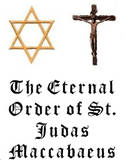
The Logos of the Maccabee

StarandthecrescentmoonCrucifixtheStarofDavidjpg-1-2-3.jpg picture by Judas999

The Maccabee, Sponsored by the Eternal Order of
St. Judas Maccabaeus, the Hammer of the LORD God the Father


StarandthecrescentmoonCrucifixtheStarofDavidjpg-1-2-2-2-1.jpg picture by Judas999

A Judeo-Christian Research Foundation


Judeo-Christian Angels Exist Right Now...


Judeo-Christian Angels Exist on both Heaven and Earth....


Judeo-Christian Telepathy, Lycanthropy, and the Evolution of Mankind is coming...


The Truth about the Judeo-Christian Tradition is already here...


Brought to you by a Judeo-Christian Research Foundation


May the LORD God bless you in the name of St. Judas Maccabaeus.